Merry Christmas

Increasingly, Christmas displays are being removed from government owned buildings. For instance the Fox News channel reported that the City Manager of Eugene Oregon, Jim Johnson banned all Christmas trees and other “religious-themed” holiday displays from almost all city-owned property, including fire stations. Many Christians were outraged over this, and he eventually relented a little and allowed fire fighters to set up Christmas trees for themselves on Christmas Eve and Christmas day.

I’m not sure why Christians should be outraged over this increasing tendency of bureaucratic officials to remove Christmas lights and trees and tinsel from government-owned buildings. Why should Christians be bothered when a public school forces parents to remove the Christmas lights they had strung about the building? After all, the first amendment is pretty clear on the fact that the government is not allowed to give special treatment to any single religion.

For years Christians have worried about the excessive commercialization of the December 25th holiday, its tendency to disappear into a time of gift giving and getting, tinsel and trees, and a jolly red-suited obese guy. Jesus is the reason for the season, we Christians have chanted. And so, I would point out, that only when Christmas was safely neutered and simply about red and green decorations could it be safely placed inside government structures. As soon as Christmas became what it actually is, a celebration of Jesus’ birth, it became dangerous.

Christians should rejoice in this removal of Christmas ornamentation from government centers. It means that we’ve won the argument. People finally recognize the true significance of Christmas. Linus’ words from the Charlie Brown Christmas TV special have finally reached the hearts and minds of the American public: the true meaning of Christmas is that Jesus came to the world to die for its sins.

Why would we want to argue that Christmas is merely cultural and should be permitted in the government’s house? Why would we ever want to de-Christianize Christmas? It is not a secular holiday. It is not about gift giving. It is about Jesus. Period. Our government has been listening and they believe what we’ve been saying all these years. Praise God! This is a good thing.

Send to Kindle
Posted in Religion | Leave a comment

Three More Preliminary Ebook Covers

Earlier this week I displayed the preliminary covers for the first three books in The Chronicles of Tableland series. Now, here are the final three covers, for books 4-6, along with a brief description of each of Books 4-6:

Sail My Darling LovelyThe Chronicles of Tableland 4: Sail My Darling Lovely

Matthew, Longren, Flet and Samantha are rescued by a floating city. The floating city has been sailing for generations across a sea of countless light years. The story of its search for Land has become a legend no longer believed, a myth taught to children and accepted only by fools. Soon after the city arrives at its destination, Matthew, Flet and Samantha disappear, leaving Longren all alone.

tablelandcover00005The Chronicles of Tableland 5: Behind the Wall

Matthew and Flet arrive in Valley, where Matthew grows to adulthood. Along the way he faces love and hate and is arrested for a grisly murder. Meanwhile, Longren and Samantha have their own struggles to face.

tablelandcover00006The Chronicles of Tableland 6: Day Come

Together again, Matthew, Longren, Flet and Samantha reach their goal beyond the southern mountains and learn, get their dreams, and realize what it is they really wanted all along.

Send to Kindle
Posted in Writing | Leave a comment

The Nearby Stars

Nearest Stars

Nearest Stars

Source SPACE.com: All about our solar system, outer space and exploration

Send to Kindle
Posted in Uncategorized | Leave a comment

Submission

The husband should fulfill his marital duty to his wife, and likewise the wife to her husband. The wife does not have authority over her own body but yields it to her husband. In the same way, the husband does not have authority over his own body but yields it to his wife. (1 Corinthians 7:3-4)

In the Christian community many teach the belief that women must learn to submit to their men. There is a serious problem with this teaching. The problem is not, as some would suggest, that women should not submit The problem is that the teaching is incomplete. In his letter to the Christian community in the Greek city of Corinth, Paul argues that men need to submit to their women just as much as women to men. He writes that in marriage, each of the two people gives himself or herself to the other: the woman’s body is no longer hers, but belongs to the man, and the man’s body is no longer his, but belongs to the woman. Obviously, Paul is simply talking about love. The more romantic way of thinking about what Paul says is to understand that in love, you give the other person your heart. It is now in the safe keeping of the beloved. You’re not your own anymore, because you’re not alone. In love, the whole concept of power and authority are supposed to go away. If one or the other is worried about who is in charge, love has not finished its work.

Consider what Jesus told his disciples:

“You know that the rulers of the Gentiles lord it over them, and their high officials exercise authority over them. Not so with you. Instead, whoever wants to become great among you must be your servant,  and whoever wants to be first must be your slave—just as the Son of Man did not come to be served, but to serve, and to give his life as a ransom for many.” (Matthew 20:25-28)

This obviously has implications for interpersonal relationships of all sorts and most certainly applies to how it works in marriage–and thus parallels Paul’s words in 1 Corinthians.

Your joy is fulfilled in seeing the joy in the other person. If both of you are focusing on the happiness of the other, giving yourself entirely to the other, then you’re both going to have a fabulous time and be completely fulfilled.

Send to Kindle
Posted in Bible, Religion, Theology | Leave a comment

The Question of Why Do Bad Things Happen…to Me?

Perhaps we should look at the question backwards.

People rarely ask, when they are blessed by prosperity, with success as the world sees success, with happy relationships, with children who are disciplined and doing well academically, socially and so on, “Why me God? Why is life so good? Why am I so blessed? Look at poor Susan over there: her life has gone to hell in a hand-basket. Why do good things have to happen to me?”

Good things happening to good people–to me–are at least as common, perhaps more so, than the other two possiblities that cause so much disturbance in our thinking: bad things happening to good people, and good things happening to bad people.

Bad things happening to bad people, or good things coming to good people seems just as it should be. We’re never disturbed about blessings. But shouldn’t we wonder about those experiences as much as the uncomfortable ones that bother us? Are the expected things–the good things that are happening to us–not just as potentially disturbing? Or do our reactions to the positive experiences versus the negative ones have something to tell us about the nature of our question regarding the suffering of the righteous? Perhaps by thinking about the uncomfortable question backwards, we can gain some perspective. Perhaps we’ll get a clue about what really bothers us, and what that says about us and our approach to life.

Send to Kindle
Posted in Bible, Religion, Theology | Leave a comment

More Novels Coming Soon

Thus far I am enjoying the process of indie publishing. The sales I’ve seen on the five novels I have up, together with my wife’s Christmas story and four of my short stories, has been in line with what I’ve been told is normal for this stage of things after only the first week. The more books I get up, the more income they should generate, and I have plenty of material that I’ve produced over the years. It’s not bringing in anything just sitting on my hard drive, so to the Kindle they shall go. To learn more about indie publishing, start with Sarah A. Hoyt’s blogpost.

And, as always, I’d appreciate any feedback or comments on these covers and the descriptions of the books; this is all still preliminary.

I have proofread three out of the six novels that make up The Chronicles of Tableland series. I still need to format them for the Kindle. And proofread them again. And I have three more books to go in the set. Here is a summary of each of the first three books of the series, together with their preliminary cover designs.

tablelandcover00001The Chronicles of Tableland I: All His Crooked Ways

For thousands of years, the Egyptian Empire and its pharaohs have ruled Tableland and its assorted nations and peoples. It is a flat world bounded by oceans that extend for light-years in every direction. Matthew becomes a slave after his parents are murdered. When Longren, a lonely hermaphrodite from an alternate universe rescues him, his despair turns to hope. Longren and his companions—a centuries old Flet, and Samantha, a much younger doctor—are hunting for the secret to immortality. Matthew joins their quest.

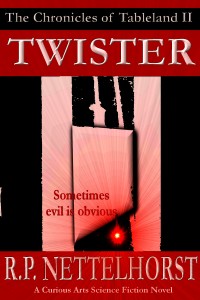
tablelandcover00002aThe Chronicles of Tableland II: Twister

Matthew, Longren, Flet and Samantha journey by land and river across Tableland in search of freedom, love and immortality. Instead, they find slavery, misogyny, and brutality. They also find Matthew’s old master. It turns out he’s a demon Twister who enjoys killing his old wives. He uses services provided by the Aztecs. Not only have they endured and prospered, they still practice human sacrifice.

tablelandcover00003The Chronicles of Tableland III: Dark Waters

Matthew, Longren, Flet and Samantha learn about the Tree of Life in the far south, beyond the mountains. They escape from religious fanatics when they are captured by pirates. Thanks to Matthew, they finally escape the pirates only to find themselves adrift in a small lifeboat in an endless ocean facing a raging storm.

Send to Kindle
Posted in Writing | Leave a comment

Book Review: Wounded

WoundedWounded
by Valerie Richardson, published by Healed Publishing, 2012

“…God doesn’t call the equipped, He equips the called.”—from Wounded.

Wounded is both an ebook available for the Kindle, as well as a paperback book available from Amazon.com. Many have been hurt by the actions and words of the people in their lives. Sometimes it is a family member, a classmate, or a teacher. Practically everyone has a story to tell about how someone has hurt them. Some have been hurt more severely than others. Some hurts can last a lifetime, if we aren’t careful.

The church should be a place of safety, a refuge from the suffering that our lives otherwise experience. Unfortunately, and sadly, sometimes the church—that is, the people who make up a congregation—can cause real pain, real harm—contrary to what the teachings of Jesus and the proper role of God’s people should be.

Valerie Richardson shares her own story of being seriously wounded when she was twelve and the effect that had on her life. She also shares the stories of others who have suffered injury at the hands of people in the church, both from pastors, from the congregation as a whole, and from individuals in the congregation.

What’s so great about the book is that the author gives good guidance on how to achieve healing from the wounds we’ve suffered at the hand of those who should love us, whom we’ve put our trust in. She stresses the importance of forgiveness, not just because it’s “the right thing to do” but also because of the benefits it will have for us. It is when we forgive those who’ve wronged us, that our healing can happen. She shares her own struggles in this regard and the benefits that have accrued for her over time.

Richardson offers no quick fix. She points out that the process of healing can take a long time.

While conflict within a church is inevitable, given that it’s made up of human beings, she explains the importance of doing everything in love, of approaching problems and issues directly with the individual that has caused the perceived problem, and how vital it is not to get caught up in gossip or talking down others, even if they have caused us pain. She also stresses the importance of doing all things with a loving and humble heart, and to recognize that in any conflict, no matter how right we may think we are, we must be willing and able to apologize and ask for forgiveness. No one is faultless in a conflict. Mistakes are inevitable on all sides, simply because of our imperfect, sinful human nature. Restoring relationships must take priority.

Richardson writes, regarding her own hurt:

“Blaming God because life is difficult or unfair is a waste of time. Could God have intervened and helped in my situation? Absolutely. But he didn’t for a reason. When I look back at the situation when I was 12 I can see so many areas God could of intervened. Things may have been different for me. I may have made different choices in my life. I might have been a different person. But that’s the point. If God would have intervened I would have been a different person, not who I am now. God knew where I would end up. If He wanted something different my life would have been different. This is what he wants from me right here and now. It’s my job to bring glory to Him right where I am.”

Richardson’s book offers practical help and valuable perspective on the pain that all too often afflicts believers.

I recommend the book to any who have suffered wounds from people in the church. And I would recommend the book to those in positions of leadership in the church: pastors, assistant pastors, deacons, elders, music leaders, worship leaders, and teachers. It can serve as a useful reminder of how problems can arise in a congregation, and what can be done to keep the disagreements and hurts between members small and fixable, before they become large and destructive, damaging the church and even more people.

You can get a paper copy of Wounded from:

https://www.createspace.com/4054132

or

http://www.amazon.com/Wounded-1-Valerie-R-Richardson/dp/1480280283/ref=sr_1_1?s=books&ie=UTF8&qid=1353071508&sr=1-1&keywords=wounded+valerie

A version for the Nook is coming.

You can follow Valerie Richardson on Twitter: https://twitter.com/vrrichardson

Or hook up with her on Facebook at Valerie Morgan Richardson

Send to Kindle
Posted in Bible, Religion, Theology, Writing | 1 Comment

Five Novels Now Available for the Kindle

Five of my novels are now available for the Kindle. Just click on the covers or the titles to get them from Amazon:

antediluviancover0001small

Antediluvian

The Solar Union and the Outworld Federation had been at peace for hundreds of years, but that time was ending. Methuselah, grandfather to Noah, was leading the Solar Union headlong toward war. When it came, civilization would fall. Powerless to stop the coming deluge, Noah risked everything to survive.

Inheritance

An old geneticist, Paul Wilcox, becomes involved with a fifty-thousand year old archeological site that will radically change the world’s understanding of its past, with implications that will change its future. The ancient site is filled with advanced, human-built technology, and an artificial intelligence that has been waiting a very long time for someone to talk to.

Somewhere Obscurely

Mohado — vulgar term applied to timeslipped workers. Living as virtual slaves, these desparate workers move back and forth through time at the whims of their employers. This is Aramond Smith O’Reilly’s life. Witness to his mother’s murder, kidnapped, and sold into a life of misery… He will never know where – or when – he will be. After escaping wretched conditions, Aramond rises above his situation. Purchasing a timeship, he becomes the very thing mohados dread and fear: a coyote–one of those who transports and delivers the workers to those who would exploit them.

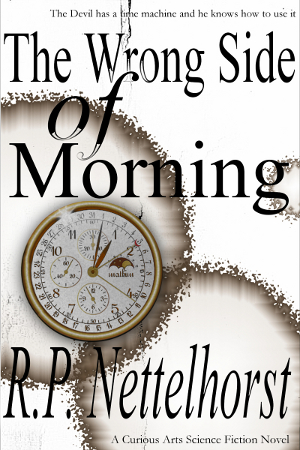
The Wrong Side of Morning

The Devil has a time machine and he knows how to use it.

Calling himself Harlequin, he is desperate to keep God from locking him away in Hell forever. He suspects that if he can make the right change in history, he’ll manage to escape God’s judgment. So he keeps trying, over and over again, to make changes in the past, present and future. Laurel Lapere, a historian from the 23rd century who watches history unfold through a time portal, notices an anomalous event and discovers that it focuses on a late twentieth century accountant named Keaton. She travels back in time to meet him, and together they soon discover Harlequin’s plan and try to thwart him. At the same time, Harlequin tries to use them to his own advantage.

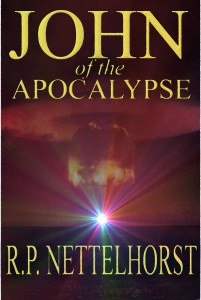
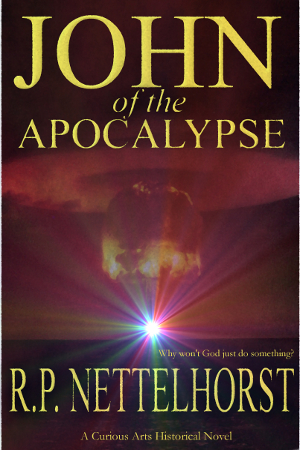
John of the Apocalypse

“Why doesn’t God do something?” It was a question heavy on John’s mind. He had seen all his companions bleed and die; thousands of his compatriots had been slaughtered by a brutal tyranny. It seemed such an odd way for God to treat his most faithful servants. By 93 AD, John was just a lonely old man exiled for his beliefs on the island of Patmos. And then Jesus unexpectedly shows up with good news and an explanation.

More novels will be coming. Next on the Kindle will be the six book science fiction series, The Tableland Chronicles. Watch for them.

Send to Kindle
Posted in Writing | Leave a comment

Implications

The number of confirmed planets circling stars other than our sun is now above 800. Seven of those planets are somewhat similar in size to Earth and swing about their stars in what’s called the “habitable zone”–meaning that water would be a liquid on their surfaces.

Recently, an Earth-sized planet was located swinging around Alpha Centauri B—part of the nearest star system to our sun. Chances are, there are other planets there yet to be discovered.

Sooner or later—I would bet within the next decade—scientists will confirm the existence of at least simple life forms elsewhere in the universe. When that happens, some pundits will announce that this means the death of religion. And some Christians will doubtless denounce the discoveries as some sort of delusion cooked up by scientists because they hate God.

Of course, both those who think extraterrestrial life proves there is no God, and those believers who fear that conclusion might be true, are equally in error. It arises as a consequence of inadvertently heretical beliefs held by far too many Christians.

By the time of Christ, the Greek philosophies which dominated the Roman Empire had developed a deep distrust of the material and a corresponding love for the immaterial. The body was conceived of as a prison of the soul, and many Greeks were horrified by the concept of physical resurrection that was a central part of Christian teaching (see Acts 17:32 for example of the reaction). But since aspects of the Greek philosophies bore a superficial resemblance to Christianity’s concepts of the spiritual, many of the new Greek converts (who ultimately became the majority of believers in Jesus) brought these philosophies with them into the new faith. They transformed the resurrection into metaphor. The resurrection disappeared, replaced by an entirely spiritual afterlife in a gauzy heaven: the clouds and harps of Hollywood imaginings.

The natural, material realm thus became fundamentally separated from the “spiritual” realm in most Christian thinking. God was equated with mystery and the inexplicable. What could be explained was then labeled “mundane.” Only what could not be explained remained a “mystery” and part of God’s realm.

This set up the problem, creating the war between science and religion. With “mystery” as the definition of God, the spiritual world must inevitably lose ground once science could explain what had previously been inexplicable. With each new discovery God seemed to vanish from the process. Where before the rain came from God, once science could explain the water cycle, it was rendered merely natural. Lightning was just electricity, not bolts of God’s wrath. Removal of “mystery” automatically became the removal of deity. Increasingly it seemed that God was nowhere to be found.

What has happened? Today, religion and religious thought are relegated to a no man’s land of mysticism and subjectivism, a place where God is somehow less than real, with an existence only as people define Him. Whether expressed or not, God’s reality and power have shrunk to become nothing more than “God helps those who help themselves.” Not surprisingly, some Christians — perhaps most — have become terrified of science, fearing that the last few wisps of their faith will dissipate when the final mysteries are explained and understood. Modern science looks out at the universe and finds little if any room for God, so small has He shrunk in the minds of too many Christians.

The fundamental flaw — or heresy, if you will — has been that separation (and the acceptance of this separation) of the natural and supernatural by Christians. Modern Christianity has become almost deistic, thinking that those things we understand, those things we can do, those things that we can predict and those things that therefore are natural and ordinary, have, after all, nothing to do with God—except that he started it all up, sometime long ago. God is simply the clock winder and builder, with everything operating by itself now.

The distinction so often made between “supernatural” and “natural” is an artificial distinction that muddles reality. Instead, one could in fact say that everything is supernatural. It is the natural — in the sense of a universe operating without God’s direct, immediate intervention — that doesn’t exist. Likewise, one could argue that there is no supernatural, everything is natural, because the existence and intervention of God is a constant–the utterly natural, ordinary way that the universe functions. Him being around and fiddling with his universe is no more out of the ordinary than me fiddling with my lawn, watering it, mowing it, and pulling weeds.

It simply is not true that God is “wholly Other” and incomprehensible to human beings. Much of what God does we do understand and can explain. Should this be a wonder to us? Why, when we are created in God’s image? Shouldn’t we in fact expect to understand both him and the universe he made and runs? God does not equal mystery. Reduction in ignorance does not make God grow smaller.

So what if there is life elsewhere in the universe? It’s a big universe, created by a big God; he can do with it as he wills. Albert Einstein said “God doesn’t play dice with the universe.” The physicist Neils Bohr responded, “Einstein, don’t tell God what to do.”

It is impossible to argue biblically one way or the other about life elsewhere in the universe. Too often, we make the mistake as Christians in imagining that the Bible must have all the answers to all the questions. It doesn’t.

The Bible is not a complete revelation to the human race. It is a sufficient revelation: that is, it gives us information about who God is and how to relate to him. It was never intended to tell us everything there is to know about everything. We’re incredibly naive if we think that. The Bible is silent on the matter of life on other worlds, as silent as it is on exactly how to go about fixing the fuel injector on my old Saturn. But just because the Bible doesn’t talk about it, I do not doubt the existence of either my Saturn or my twitchy fuel injector.

Send to Kindle
Posted in Bible, Culture, Religion, Science, Space, Theology | Leave a comment

Scapegoating

These are some random thoughts about the horrific events at Sandy Hook Elementary School in Newtown, Connecticut.

Scapegoating is the non sequitur and unmerited negative treatment or blame of someone for a problem. Scapegoating may be conducted by individuals against individuals (as in, “John made me do it!”), individuals against groups (for instance, “I failed because our school favors girls”), groups against individuals (as in, “It’s Bob’s fault that we lost the game.”), and groups against groups (“Immigrants are taking all of the jobs from ordinary Americans.”).

A scapegoat may be an adult, sibling, child, employee, peer, ethnic or religious group, or country, or even an inanimate object.

The appeal of scapegoating is that it reduces a complex problem to an illusionary simplicity. It creates the mirage that the problem can be solved simply by getting rid of the offending individual, object or group.

So today, the pundits are in full scapegoating mode. But rather than some group being blamed for the shooting, the guilt is being laid before objects.

Some commentators were quick to blame the shooting on violent video games.

Others blamed “a violent society that glorifies violence.”

And of course, the favorite scapegoat of all: guns.

Unfortunately, such scapegoating does not actually address the true problem at all. Nor does it keep what happened in any kind of perspective, admittedly difficult to do in the midst of the shock.

Consider a bunch of statistics:

It is estimated that at least 80 million Americans own guns. There are about 258 million guns distributed among these 80 million Americans.

The majority of gun-related deaths in the United States are suicides, with 17,352 (55.6%) of the total 31,224 firearm-related deaths in 2007 due to suicide, while 12,632 (40.5%) were homicide deaths. (Incidentally, that’s about the same number of people who were killed in car accidents–around 32,000–in the US that year)

So, 285 million guns resulted in 31,224 homicides.

That works out to about .4 percent of the guns in American being used for killing. It also means that about 99.6 percent of guns were not used to kill people.

For me, it becomes hard to believe that guns are the cause of the problem.

The same thing with violent video games. The new game, Black Ops 2 sold 11 million copies just in its first week of release. The number of the players of that game–or of any other violent video game–who commit murder are vanishingly small.

We could point out that over ninety percent of Americans ate a hamburger in 2007. About 17,000 Americans committed murder, with over 90 percent of them having eaten a hamburger at some point prior to their crimes. It seems to me unlikely, however, that hamburger eating will ever be imagined to be a cause for those murders.

Which illustrates, I think, the ludicrousness of blaming inanimate objects for the actions of a volitional agent. Here’s a thought. Why not just blame the murderer for his actions instead of his neighbors, the community, or whatever thing it is in our society that you don’t like.

Continuing with some more statistics regarding video games. Apparently, about 68 percent of American households play video games. Over 90 percent of those under the age of 17 play video games.

And yet the crime rate in the United States has actually been steadily declining over the last decade, violent crime has been plummitting. Murder rates are down. For instance, NBC news in June 2012 reported FBI statistics (http://usnews.nbcnews.com/_news/2012/06/11/12170947-fbi-violent-crime-rates-in-the-us-drop-approach-historic-lows?lite) indicate that violent crime rates in the US are approaching historic lows.

And now on to some more general statistics regarding death.

In 2010 deaths from all causes numbered about 2.5 million.

The top 15 causes of death were:

1. Heart disease
2. Malignant neoplasms
3. Chronic lower respiratory diseases
4. Cerebrovascular diseases
5. Accidents (unintentional injuries)
6. Alzheimers disease
7. Diabetes mellitus
8. Nephritis, nephrotic syndrome and nephrosis
9. Influennz and pneumonia
10. Intentional self-harm (suicide)
11. Septicemia
12. Chronic liver disease and cirrhosis
13. Essential hypertension and hypertensive renal disease
14. Parkinson’s disease
15. Pneumonitis due to solids and liquids

Those top 15 causes of death cover about 2.1 million of the deaths in 2010; the remaining 400,000 or so deaths are come from all other causes.

The total percentage of people who died in the United States in 2010, from all causes amounts to about .8 percent of the population. In other words, in 2010, 99.2 percent of the American people did not die.

Perspective is a useful thing to have, but rarely do we hold on to it.

What happened at that elementary school in Connecticuit is heartbreaking and horrific. But looking for scapegoats for its cause will not prevent such terrible things.

And yet we all want to keep such horrors from ever happening again.

But if we can’t solve the issue by simply banning guns, banning violent video games, or banning violence in movies and television, then what can we do to try to solve the problem and prevent such violence?

And still, our first impulse, always, is to find someone, something to blame and make that someone or something disappear.

Unfortunately, it isn’t that easy. We must resist our first impulse. Scapegoating, for all its emotional appeal, does not actually solve a thing. It merely deludes us into thinking we’re doing something, taking a stand, making a difference. Instead, we’re acting more like the ancient people who danced and made noise to drive away the dragon consuming the sun during a solar eclipse.

So what causes crimes such as what we saw at that elementary school?

We could, as many Christians do, point to the general fallen nature of humanity and our need for redemption. Evangelizing our neighbors is certainly a good thing. But turning people into Christians does not mean that they will suddenly become perfect and righteous. King David, a man after God’s heart, committed adultery and murdered his paramour’s husband. Moses murdered an Egyptian. We regularly read about pastors embezzling funds, committing adultery, being guilty of pedophilia. We also read about Sunday School teachers, deacons, and ordinary pew sitters, teachers and police officers, firefighters and soldiers–human beings–committing sins.

Evangelism is good, but it won’t actually eliminate bad behavior. Christians are still sinners, after all. Making children recite prayers, posting copies of the ten commandments, or forcing Bible reading in the schools will not prevent crimes. America did not start skipping to Hell with joyful abandon when forced rote prayers were eliminated from public schools. You don’t always obey the speed limit, despite the regularly posted signs. What makes you think posting religious stuff or imposing religion will have any more impact on the criminal or insane?

So.

We live in a society that values its liberty and privacy. We don’t like being told what to do or where to go. We don’t want surveillance cameras watching our every move. We don’t want police on every corner eyeing us. Making America resemble an airline terminal run by the TSA is not a reasonable solution, either.

Such violence as we saw in Connecticut is newsworthy not because it is common, or an epidemic. It is news because it happens so infrequently. The vast majority of the hundred million or more school children did not face bullets today, nor did their teachers. The overwhelming majority of people in the US today were not the victims of violent crimes or crimes of any kind.

We would all like to see such things never happen again. We would all like to find a way to keep it from ever happening again.

Rather than scapegoating groups or objects, we may have to recognize that our ability to keep bad things from happening is limited and that solutions are often very, very hard. A person who would kill his parents, kill a bunch of children, and then kill himself is obviously suffering from mental illness. Unfortunately, mental illness is hard to treat. The states have severely reduced the amount of money they devote to the treatment and care of the mentally ill, and when combined with well-intentioned but misguided laws that prevent involuntary commitment, the mentally ill are left to wander the streets still sick (the overwhelming majority of the homeless are mentally ill, despite having treatable illnesses. But the current laws make it difficult or impossible to help them).

What to do? Some thoughts:

1. Increase funding and care for the mentally ill and change the laws so that those who resist treatment can be forced to get the help they need; this is for their own good, as well as for the good of society (as in preventing, to some extent, what happened in Connecticut).
2. Recognize that crimes are the result of individual choices by individuals. We do not share collective guilt for what an insane person or a criminal does. We must not use such incidents as an excuse to blame our political opponents. No one wants to see such things happen. Attributing malice to your political opponents, arguing that their policies mean that they like to see children murdered, and want it to happen more, demeans you. And you sound like an idiot and worse. Surely you know better. It is also not good to use such incidents to create scapegoats or build strawmen.
3. Recognize that it is impossible, in a free society–or really, any kind of society–to completely prevent the insane or the criminal from causing harm to individuals and groups.
4. Resist the urge to feel guilt for the crime of another. Be willing to let the guilty bear the responsibility for their own actions without spreading the guilt around, throwing it at those you disagree with, or picking it up for your very own.

Send to Kindle
Posted in Uncategorized | 1 Comment