Over a Cup of Coffee: Why History Matters

An old friend and I got together one afternoon to drink coffee and catch up; since she had moved to Colorado, it had been a few months since we had seen each other. As she picked up her cup, she winced. Did she find something about the coffee or the cup disturbing? Had I said something to upset her? So I asked her what was wrong. She told me about an accident at work and how she was going to have to have some minor surgery on her shoulder. It just hurt sometimes.

The historian, R.H. Tawney is quoted as saying that, “the world seemed an odd place, and I wondered how it got that way.” If I was going to understand why my friend winced when she picked up her coffee cup, I was going to have to learn what had happened to her when I wasn’t around. In the same way, we see the world wincing in various places. Why? Why can’t people just get along? Why the fighting and feuding?

Take one example: why can’t the Palestinians and the Israelis just get along?

Following the destruction of Jerusalem and the burning of their temple by the Romans back in the first century, most of the Jewish people had been forced out of their ancestral homeland (perhaps ten to fifty thousand remained there at any given time, between the first century and the beginning of the twentieth century). Large numbers of Jewish people began moving back to Palestine in the early part of the twentieth century. This organized movement to return the Jews to their ancestral homeland was called Zionism. Why did they want to move to Palestine? After fifteen hundred years of being persecuted and murdered in European exile, some of the Jews decided they would be safer if they could have a country of their own.

Following World War I, Great Britain took over control of Palestine from the Ottoman Turks. Why? Because Turkey had fought against England on the side of Germany and Germany had lost. Great Britain issued what is called the Balfour Declaration, promising the Jewish people that they could create a Jewish homeland in part of Palestine. But the British gave contradictory statements to the Arabs of the region, promising them that there would never be a Jewish homeland there.

In 1948, following the end of World War II, the United Nations voted to establish two nations in the British protectorate of Palestine: a Jewish homeland, called Israel, and a Palestinian Arab state. Unfortunately, the surrounding Arab nations refused to accept a Jewish presence in the Middle East and immediately declared war on the nascent state and attacked from three directions. To the surprise of most, Israel managed to survive. What of the lands that were to be made into a Palestinian Arab state? They were simply annexed by Egypt and Jordan. Between 1948 and 1967, Jordan held the West Bank and Egypt held the Gaza Strip and treated them as their own territories. In 1967, Egypt, Syria, and Jordan attacked Israel again. Six days later, the war came to an end, with Israel now in control of the West Bank and Gaza Strip, as well as the entire Sinai Peninsula.

In the 1980’s Israel gave the Sinai Peninsula back to Egypt in exchange for a peace treaty. In so doing, Israel gave up the only oil deposits to which it had access.

The Palestine Liberation Organization had been founded in 1964, three years before Israel took control of the West Bank and Gaza. Its charter sets as its goal the destruction of the nation of Israel. A question: if the Palestinian cause is so precious to the Arab nations, why didn’t they help them form an independent Palestine when Arab countries controlled that territory? For that matter, why didn’t the Palestinians send suicide bombers against their Jordanian and Egyptian occupiers? And why didn’t the United Nations pass resolutions condemning the Jordanians and Egyptians, like it today passes against Israel?

Could it be that there is a little anti-Semitism at play here? For over fifteen hundred years the hatred of the Jews has been a common theme in the world, especially in Europe. It led to the ultimate horror of the Nazi Holocaust. In the 1930s, thanks in large part to the Nazis, much of that ancient European anti-Semitism made its way into the Arab world. Sad to say, it has been swallowed there in all its virulence: hook, line and sinker. Daily, the Arab media pour forth the old Nazi lies which are now widely accepted in that part of the world.

If a problem in the world were easy to solve, and uncomplicated, then it would have been solved already. Problems that have taken decades or even centuries to create, are unlikely to be solved overnight. If we can get a little historical perspective, we might be able to understand a little bit about why things are happening, and then, perhaps, we’ll have some chance of coming up with a fix.

Otherwise, like my friend over coffee, if I hadn’t found out about her work injury, I would never have understood why she winced, or I might have imagined a wrong cause.

Send to Kindle
Posted in History | Leave a comment

The Philodendron

We’ve had problems with the alarm system at our church for a very long time and recently we finally got it back in working order. It brought to mind an odd incident from the past. About five years ago I purchased a philodendron for my office at the Quartz Hill School of Theology, which is a ministry of Quartz Hill Community Church. It was supposed to replace the plant that had died the previous summer when I was gone for a couple of weeks and I forgot to tell anyone to water it. The sudden motivation to purchase the philodendron came when I learned I would be interviewed by a local reporter about my book, The Bible’s Most Fascinating People, which had just been released. I decided a plant in that pot of dry dirt would look better than a handful of scraggly brown stalks.

The plant was healthy the day of the interview, though I did note that one of the leaves had fallen off and was lying on my desk. It seemed a perfectly healthy leaf but things happen. I picked it up and tossed it away.

The interview was on Tuesday. Thursday night, when I came in to teach class, I noticed a whole limb had fallen from the plant and was lying in the trash can next to my desk. Again, I thought that was a bit odd. But on Wednesday we have youth group. My office is in the church, whose facilities the School of Theology makes use of. So, I thought perhaps one of the teenagers, for whatever reason, had perhaps knocked a branch off.

Saturday, when I taught Hebrew, I saw a few other leaves off but simply tried not to think about it. Monday night, when I taught class, there were an enormous number of leaves missing. At that point I became convinced that it was my youngest daughter, who, for reasons known only to her, had perhaps gone wild with the plant and plucked leaves off of it. I even saw a pair of needle nosed pliers on my desk, taken from a drawer, and thought for sure that was the implement of my poor plant’s dismemberment.

But when I went to church the next Sunday morning, the plant was now only a shadow of its former self: a couple of branches and a handful of leaves. But my daughter had not been there to do anything: she had thrown up that morning and had not come to church since she was sick. And yet here my poor plant was nearly destroyed. Perhaps it was those inconsiderate teens from the youth group. Why would they do that to my plant?

Sunday night, I returned for our small group study. When I went into my office, I discovered my plant was now entirely gone: just roots. Every last branch, every last leaf had been plucked from it. On top of that, the wireless access point that had been sitting next to the plant had been knocked over. Very curious.

I carried the empty pot into the foyer and showed the few people there my now non-existent plant. “Who would do something like this?” I wondered.

“It looks like something that an animal might do,” suggested Kathy, our pianist, poking at one of the nubs barely visible in the dirt. Look, you can see chew marks.”

I looked. She was right.

“The squirrel!” I announced.

People in the foyer stared at me, not quite as if they believed I had lost my mind, since they’d known me for years and my oddness was something they’d grown accustomed to. More it was a look of, well, confirmation—as in, “ah, once again he demonstrates for us just how peculiar he is.”

But then I explained, reminding them of the then recent past. We had, over a period of about a month, suffered from the alarm system in the church going off repeatedly for no apparent reason. I would receive a call from the alarm company, tell them to shut off the racket, and then I would drive over to the church to see what was wrong. Every time, I would find the building secure: all the doors closed, windows closed and intact, and no evidence that anything was out of the ordinary. This happened two or three times a week and we simply could not figure out what was wrong. The alarm company had been unable to find anything amiss with the system.

Then, one Saturday afternoon when I arrived to teach a Hebrew class, I walked back to the library to set up the room for the students, and just as I reached the door, I saw two shiny black eyes staring at me from the middle of the carpet: they belonged to a squirrel. Startled, it stared at me, then flicked its tail, and scurried toward one of the book shelves. Recovering from my surprise, I walked into the room, at which point the beast scurried past me and darted down the hallway. I turned to follow, but when I looked down the hall it was nowhere to be seen.

So, the mystery of the random alarms was solved. And since we were unable to figure out how it was getting into the building, we began, after that point, to always set the alarm in such a way that the interior motion sensors were shut off. My discovery of a squirrel in the building had also explained a puzzling incident over the summer when we came into the church and found biscuits scattered all over the kitchen floor: someone had left a bag of them on the counter-top one Sunday and we found the mess when we arrived for Wednesday Prayer Meeting. Now it seemed probable that the squirrel was behind that dishevelment.

Remembering the squirrel had solved the new mystery of my slowly vanishing plant: apparently the bushy-tailed creature finds philodendrons tasty. Though given the number of leaves and branches that were just scattered about rather than consumed, perhaps the squirrel merely has a personal grudge against them.

Send to Kindle
Posted in Uncategorized | Leave a comment

Mercury Seven

Fifty-four years ago, on April 9, 1959 NASA picked its first group of astronauts. There were seven of them and they instantly became household names: Alan Shepherd, Gus Grissom, John Glenn, Scott Carpenter, Wally Schirra, Gordon Cooper, and Deke Slayton. Called the Mercury Seven, they are also sometimes referenced as the Original Seven, or more formally, Astronaut Group 1. NASA’s latest astronaut class is now Group 20, which joined in 2008; Group 21 should be named sometime this year.

The Mercury Seven were famous before they did anything except train for their spaceflights. They appeared on television, in magazines, and newspapers and were treated like modern rock stars.

Since then, hundreds of astronauts have followed them into space. Very few of them are well-known. If you asked the average person to name a current astronaut, he or she would likely have trouble. Most of the astronauts since those first seven have flown in obscurity. The average person would be hard pressed to give the names of either of the two astronauts currently circling the globe inside the International Space Station. In fact, most people would be surprised to even know that American astronauts are currently in space, and in fact have been continuously in orbit since November of 2000. Seven is the normal crew size now of a single shuttle flight. And come May, seven astronauts—the sum total of the entire astronaut corps of 1959—will be flying to the Hubble Space Telescope to conduct its final repair and upgrade mission.

But in 1959, space travel was fresh and new and we were worried about the Soviet Union, which at the time seemed to be beating us in all things space-related. They had beaten us to orbit with the first satellite, Sputnik 1, launched less than two years earlier in October 1957. And in 1961, Yuri Gagarin , a Soviet citizen, would be the first man to orbit the earth, a feat that would not be matched until John Glenn rode an Atlas booster into space in February 1962, when he became the third person to reach orbit. The Soviets had managed to launch a second person into space before he made his first flight.

Interestingly, astronauts of the Mercury Seven are the only astronauts to fly aboard all the human rated spaceships that NASA has flown up to now. Six of the seven rode in the one-seat Mercury capsule. Three would go on to fly on the next generation spaceship, the two passenger Gemini. Three would fly on Apollo, the three person spaceship designed to go to the moon (another would die on the launch pad in Apollo 1, which never flew). One of those three, Alan Shepard, Jr. made it to the surface of the moon on Apollo 14. And one, John Glenn, would even fly on a Space Shuttle.

Of the seven original astronauts, only two of them are still alive: Scott Carpenter and John Glenn.

All told, as of January, 2013, only 530 human beings, from 38 countries have reached 62 miles or more above Earth and can therefore be said to have flown into space. Of that number, 527 have reached low Earth orbit (more than half were Americans). Only 24 have traveled beyond Low Earth orbit to either circle or land on the moon (and three out of those 24 did it twice).

John Glenn, one of the original Mercury Seven astronauts, besides having the distinction of being the first American to orbit the Earth, is also the oldest human being to ever go into orbit. He was 77 years old when he flew on STS 95 in 1998 on-board the twenty-fifth flight of Space Shuttle Discovery (and the 92nd mission flown by a Space Shuttle). Gordon Cooper’s claim to fame, as the last of the Mercury Seven to fly in a Mercury spaceship (Deke Slayton would not fly until he got a trip aboard the last Apollo mission, the joint rendezvous Apollo-Soyuz Test Project, in 1975), was to be the last American to ever fly into space by himself (not counting the suborbital trips of SpaceShipOne). Since then, there have always been at least two aboard any American spacecraft.

As of today, eighteen astronauts have died during spaceflight (not counting those who died in ground accidents). The loss of life occurred on four missions: thirteen Americans, three Russians, one Ukrainian, and one Israeli.

Only one of the Mercury Seven astronauts died on the job: Gus Grissom. He was killed in an accident in 1967 aboard Apollo 1 during routine testing on the launch pad. A fire, started by a spark from bad wiring, ignited in the cabin of his capsule, killing him along with his two crewmates, Roger Chaffee, a rookie who had never been in space and Edward White, the first American to perform a spacewalk.

The other four Mercury Seven astronauts who have died succumbed to illness and old age.

Send to Kindle
Posted in Space | Leave a comment

Jamaican Blue Mountain

Jamaican Blue Mountain Coffee is a classification of coffee grown in the Blue Mountains on the island of Jamaica. It is a very mild coffee which lacks the bitter aftertaste one endures with most brews. The Blue Mountains of Jamaica are located between Kingston to the south and Port Maria to the north. Rising to 7500 feet, they are some of the highest mountains in the Caribbean. The climate of the region is cool and misty. It rains a lot. The soil is rich with excellent drainage. Nearly perfect conditions for growing coffee.

The Coffee Industry Regulation Act of Jamaica specifies what coffee may use the label Blue Mountain. Generally speaking, coffee harvested from the Jamaican parishes of Saint Andrew, Saint Thomas, Portland and Saint Mary may be called Jamaican Blue Mountain coffee if it is grown at elevations between 3,000 and 5,500 feet. Thus, there is only a very small amount of Jamaican Blue Mountain coffee in the world.

It is not a kind of coffee I drink very often. In fact, years–even decades–will pass before I imbibe.

And there is a very simple reason for my general estrangement from the best coffee I’ve ever drunk: given its rarity, it is incredibly expensive. It goes for anywhere between thirty and forty dollars per pound. Ouch! On the amount of money that I have to spend each month, the cheap store brand that sells for around a dollar or two a pound will be just fine, thank you very much.

When Lancaster experienced record low temperatures a few years ago, the pipes in our church building froze. This was not a good thing. When they finally thawed out, just as our morning worship service was about to start, we discovered that a pipe above the hallway outside one of the restrooms was leaking. We quickly shut off all the water to the building.

My task on the next Saturday morning was to repair that pipe. Or at least try. My motivation: that way we would have water in the building on Sunday morning—meaning that we would be able to make coffee. The cheap dollar a pound variety, of course. My church is not exactly flush with cash, either.

I had brought my tools for working with pipes with me when I arrived around ten in the morning: a butane torch, solder, flux, a jigsaw with a metal cutting blade, a hacksaw, and an extension cord. I met our pastor, Don Patterson and we got to work on trying to fix the problem. I got the ladder from the shed and then climbed into the attic where I could see two obvious holes in the copper.

So, we drove to Lowes and picked up a couple of clamps—metal clamshells with a rubber section that can be put over a leak in a pipe, then bolted shut. There were already five such clamps on that length of pipe, so this wasn’t the first time such a fix had been made up there. So I attached the two clamps we’d gotten and Don turned on the water. I immediately saw three smaller leaks I had missed before. He turned the water off.

Then we made another trip to Lowes, to get more clamps. Four of them. I used them all and found out about two more leaks left after we turned the water on again. Lowes had no clamps left, so we traveled to Home Depot. We found two there. I attached them. Don turned the water on. Still more leaks appeared.

Don went to a hardware store in Quartz Hill and found three clamps; however, only one of them was the right size. That left one unclamped leak. So we drove to two other hardware stores. No clamps in either place. All sold out. But we did find some epoxy stuff that was supposed to fix leaks.

I tried that. It didn’t work.

So what to do? I had two ¾ inch clamps which didn’t fit the ½ inch pipe. But, by folding some extra rubber strips, I managed to jury-rig one of the clamps and actually made it work.

Don turned the water back on. No more leaks! At last! I looked at my watch. It was 4:45 PM. All done. Well—except for making an unplanned repair to the ceiling in one of the classrooms. I had earlier slipped and plunged my knee through it. Thankfully I did not fall through the ceiling and land on the floor—although that would have made for a much funnier story.

Sunday morning before Sunday School, I learned that Don had told everyone about my fix-it job the day before. He had blabbed it from the pulpit during announcements at the first service and told everyone that they should bow before me in thanks. As I was making coffee in the kitchen, I commented to someone that my real reason for fixing the pipe had just been so I could drink coffee.

“Tell me,” said our music leader, “what’s your favorite kind of coffee.”

I admitted my fondness for Jamaican Blue Mountain.

“Then I’m going to go get you some.”

I warned him that it was very expensive, but he was not to be deterred.

Therefore, I was soon able to renew my acquaintance with the best coffee on the planet. A broken water pipe and a long day of volunteer work had turned out to be an unexpected blessing after all.

Send to Kindle
Posted in Uncategorized | Leave a comment

Model Rocket Launch

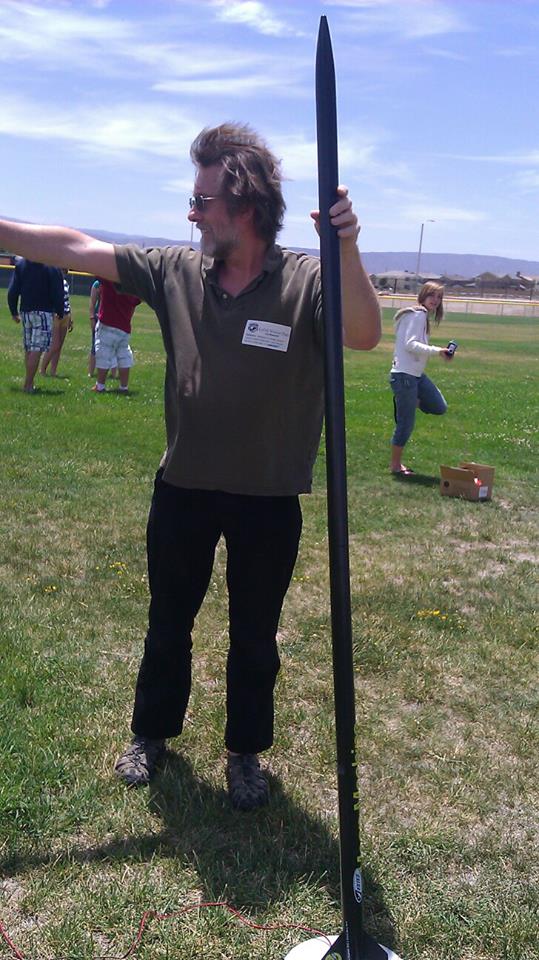
Today I went to my daughter’s school to launch a rocket for her astronomy class. The rocket I launched was a large one: my daughter had been telling her classmates about it and several of them did not believe in a model rocket more than six feet tall. My daughter was delighted when I walked into her classroom carrying the thing.

The wind was blowing much stronger than we had anticipated, and that created some difficulties in launching the rocket. In fact, I had a pre-launch incident that actually damaged the rocket slightly prior to launch: the wind took hold and pulled one of the launch lugs off the side of the rocket. Fortunately, I was able to do a temporary fix and taped it back on. Then we had trouble with the electrical running to the igniter: one of the clips pulled loose. But finally, in the end, all was well and we successfully launched the rocket and recovered it in an undamaged state.


Click on the PLAY button. Or, RIGHT CLICK here and SAVE AS to your computer, and then OPEN after the download completes.

Here are some photos of me with the rocket. First, is a picture just prior to launch. The wind really caught hold of my hair, demonstrating that I probably need to have my hair cut:
rocketprelaunch

And here I’m trying to get the clips to stay put on the igniter:
rocketigniterissue
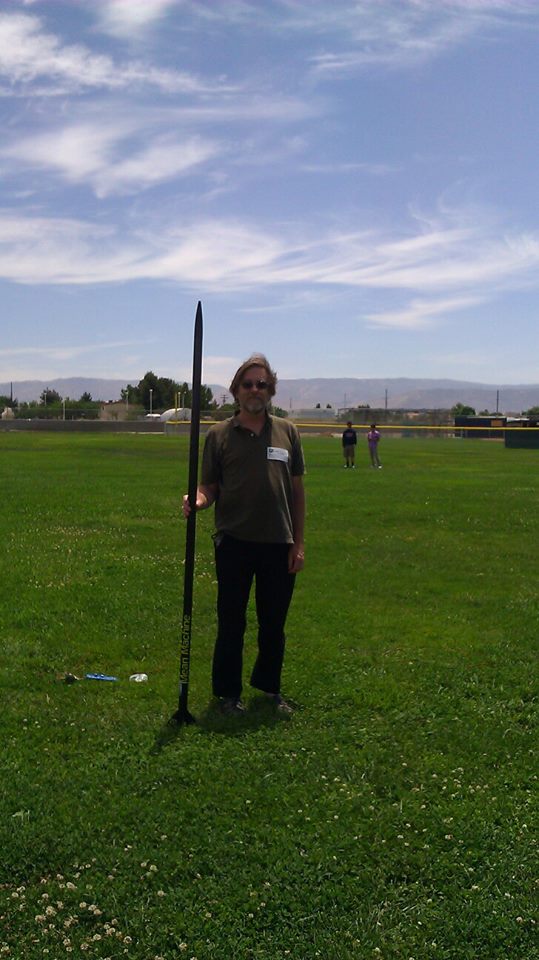
And here is a picture following the rocket launch:
rocketpostlauch
For those interested in such things, the rocket is a model available for purchase. The kit was manufactured by Estes and can be purchased through Amazon.com.

I used the largest recommended rocket motor for this launch, an E9-6.

Send to Kindle
Posted in Science, Space | Leave a comment

Locusts

The science fiction author Jerry Pournelle has been keeping a blog on the internet since before the word “blog” was invented. He simply called it a journal and it is located at www.jerrypournelle.com. Every so often, he’ll comment that “my day was devoured by locusts.” The phrase itself is derived from the Bible, specifically the book of Exodus. After several of the plagues had devastated the country, locusts beyond counting descended, eating everything that hadn’t been destroyed by the earlier disasters.

Jerry Pournelle is not suggesting that his day was a disaster when he writes that it was consumed by locusts. Instead, he means that his plans for the day—writing—never came to fruition. Instead, his day was taken up with one distraction after another.

Every so often I have a day like that. Take a certain Monday not all that long ago. Not much of a surprise that a Monday would be consumed by locusts, since Mondays are the days that murder the weekend.

Who likes Mondays?

I had good intentions for getting a bunch of writing done, despite the rejection on a short story over the weekend. Even published authors will still receive rejections. In fact, my rejections come nearly as frequently as they did before I got published.

If you’re an unpublished author, disabuse yourself of the notion that publishers will swoon over your every word just because you got a positive response from one editor. There are still hundreds of other editors who have never heard of you. They don’t care about your past success. All they care is that you give them something they want and need today. And it’s really all about the individual editor’s requirements just now: they need to fill a hole in their magazine that is 1200 words deep. If your story is 2000 words, guess what? You’ll get rejected. Your story simply didn’t fit. It had nothing to do with talent. But the editor won’t explain why you got rejected. You’ll still get the standard form letter.

In any case, my head was not in the best place that Monday morning. I had just sat down to start writing when my wife sent me a text. She had forgotten her lunch. Could I please take it to her?

So, up I got, put on my shoes, and headed across town to her school.

An hour later, I was back at my desk.

Then my daughter called. She didn’t feel well. Did I have the phone number of the doctor?

I looked it up. Just because my children are not at home, just because they are in college or high school, does not mean they cannot interrupt my day nearly as frequently as they would if they were home. They have cell phones.

Once again, I turned my attention toward my computer. The phone rang. It was my mother-in-law. She needed to tell me about a strange phone call she kept getting. “It’s some 800 number and they never leave a message. They must know when I’m at home because there were no calls like this when I was out of town.” Um, you were out of town. How would you know?

She wanted to call her phone company to see if they could do something about it. But she didn’t have their phone number. So could I find it for her?

She has a computer, but she doesn’t really know how to use it. And she knows I’m good at finding things like that, so a phone call to me was easier than using Google on her own.

Before I knew it, it was lunch time.

After lunch, I suddenly had emails that needed my response. Then there were more phone calls. Then the dog needed me to let it into the back yard so he could bark at the neighbor’s dogs. Then the dog wanted to be inside instead. After that, the cat decided that she didn’t have enough food in her bowl—she could see the top edge—so she meowed loudly and plaintively until I made it mound up again.

She has me well-trained.

Then I remembered that my other daughter needed me to wash her bedspread because the cat had thrown up on it last night.

There is more to writing than just pounding at the keyboard. Interruptions are deadly to the creative process. One needs to collect one’s thoughts, and formulate the words. It takes some doing to get oneself into the state of mind where writing happens. A certain amount of uninterrupted time is vital for the words to solidify in my thoughts and make their way from my brain to the computer screen.
But on this Monday, the locusts kept swooping down and eating the words. Every time I was about to write, an interruption chased my thoughts away.

On a good day, a day not consumed by locusts, it is easy to write my normal goal of two thousand words. On a day of locust swarms, I’m lucky to make even two hundred words.

By the time the locusts were finally gone, the day was also gone. I had to get in my car and go pick up my children from school. My wife would be home soon. And then I would have to make supper.

That particular Monday wasn’t a bad day. There were no disasters.

But as far as writing was concerned, as far as fulfilling the goals I had for the day, it just didn’t happen. Jerry Pournelle’s locusts were fat and happy. Me, not so much.

Send to Kindle
Posted in Writing | Leave a comment

Dwarf Planets

What’s in a name? That which we call a rose
By any other word would smell as sweet.
—From Romeo and Juliet (II, ii, 1-2)

As we contemplate the fact that Pluto is now to be classified as a “dwarf planet,” becoming one of a class of similar objects beyond Neptune, some people may feel a bit sad. The reality, of course, is that Pluto has not gone anywhere, and nothing has changed in the shape of our solar system. The astronomers are simply changing and clarifying how we classify the objects that make it up.

Consider the story of Ceres. It was discovered on January 1, 1801 by Giuseppe Piazzi. With a diameter of about 590 miles, Ceres is by far the largest and most massive body in the asteroid belt: it contains approximately a third of the belt’s total mass.

Initially, Ceres was classified as a planet. In fact, it held that classification for nearly fifty years. Eventually, however, as other objects were discovered littering the space between Mars and Jupiter, it was reclassified, joining this mass of rocks as simply the largest of the debris that fills that region of space. Ceres did not suddenly vanish in a puff of pink smoke. It simply was reclassified, to make better sense of it, to put it into a category in which it better fit.

Likewise, Pluto has not suddenly vanished. The New Horizons space ship on it way to Pluto has not been recalled because of its new designation as a “dwarf planet.” But it is a reasonable reclassification which helps us better understand the structure of our solar system. As more and more observations of the edge of our solar system have been made over the last decade, astronomers have found a large number of objects out there, all of which are similar to Pluto, and many of which are nearly as large—or, in the case of UB313, nicknamed Xena, actually larger (though both are considerably smaller than Earth’s own moon). These objects are called Kuiper Belt objects (KBOs).

The first astronomers to suggest the existence of this belt were Frederick C. Leonard in 1930 and Kenneth E. Edgeworth in 1943. In 1951 Gerard Kuiper suggested that the belt was the source of short period comets (those having an orbital period of less than 200 years). More detailed conjectures about objects in the belt were done by Al G. W. Cameron in 1962, Fred L. Whipple in 1964, and Julio Fernandez in 1980. The belt and the objects in it were named after Kuiper after the discovery of (15760) 1992 QB1. Although no known object in the Kuiper belt is a possible candidate to become a comet, the name Kuiper for the region has stuck.

And like Pluto, these KBOs orbit the sun in highly eccentric orbits between 30 and 50 AU from the sun (AU is “astronomical unit,” the distance from the sun to the Earth, about 93 million miles). Pluto has a highly elliptical orbit that sometimes brings it closer to the sun than Neptune. It is canted to the ecliptic—the level at which the eight planets orbit the sun—at a 17 degree angle. UB313, which also has a highly elliptical orbit, is canted at a 44 degree angle, and is sometimes further from the sun than Pluto, and sometimes is closer than Neptune. Other major objects out on the edge of the solar system include Sedna, Ixion, Varuna and Quaorar, all larger than Ceres. All together, more than 800 of these Kuiper belt objects have been discovered; astronomers anticipate finding thousands more. Given their size and relationships, thinking of these objects as “planets” like the other eight seemed unreasonable to the astronomers gathered in Prague in August, and so Pluto, as being an obvious member of this group—simply the first one of them to be discovered—needed to be redesignated.

Our solar system is simply a far more interesting, wonderful and complex place than people first thought in the early part of the 20th century and the classification—or reclassification—of the objects within it, is simply a way of helping us more easily comprehend and organize it in our minds. Designating Pluto, and the other distant bodies like it, as “dwarf planets” makes it much easier than trying to memorize a planetary list which otherwise would have grown to the hundreds, if not thousands. Chances are, in the future, we’ll have to make more adjustments in our thinking, too, especially as the details of other solar systems around neighboring stars become clearer.

Send to Kindle
Posted in Science, Space | Leave a comment

Living With Mental Illness

In many respects, living with and caring for a mentally ill person is like living with any chronically ill individual. The condition does not change much from day to day, and they require constant attention.

Some chronically ill individuals are bedridden. Extra effort is required to ensure they take their prescribed medications. Some need help with even the most basic activities: bathing, feeding, brushing of teeth—even going to the bathroom.

A friend of mine was a live-in caregiver for a bedridden woman who was very old; when he first started working with her, she could get around with a walker. Soon, she became confined to a wheelchair, though she could move it herself. But as the years went by, she became increasingly immobile, while the other things she could do for herself became ever less.

Until the end, she was able to feed herself, but my friend became responsible for making sure she could get to the toilet, could get from her chair into her bed, and even to bathe.

For a few years, he was able to take her with him to baseball games—she was a big fan of the Dodgers—and to a few other events, such as weekly church services. But eventually, she could no longer go anywhere. By then, because of her condition, he could leave the apartment for only very limited periods of time. Occasionally he could get a day away—but only when he could get a substitute care worker to take his place. Otherwise, he was limited to brief trips to do the grocery shopping or the running of a few errands—and never for much more than an hour.

Other people with chronic illness merely need to be watched and sometimes directed; or given extra aid now and again: perhaps picking them up and taking them to weekly physical therapy sessions or other appointments, reminding them to take their medications, and checking to make sure they are eating properly.

My youngest daughter, a teenager, is now on an antipsychotic medication. She is not bedridden. She can visit friends, do occasional sleepovers with them, or have them come and stay with her overnight. This is an improvement on where she was two years ago. Then, she could not be left alone at all; in fact, it was hard to even go to sleep at night because of her tendency to sneak out of the house. In contrast to my friend’s elderly patient who steadily declined, my daughter’s condition has improved and continues an upward path. Her psychiatrist is pleased with her progress.

My daughter now sleeps through the night and no longer tries to sneak out or run away. But she really cannot take care of herself; and because of her emotional volatility—much better and less extreme than it used to be thanks to the medication—we still cannot leave her alone for more than two or three hours at a time. Sometimes she is stable and patient and clear thinking and all is well; other times she explodes in an extended rage over the most minor of inconveniences, such as misplacing her iPod or simply being asked to take an empty glass back to the kitchen. She is not always very good about distinguishing between fantasy and reality. She’ll start perseverating on a topic, making up scenarios and events that never occurred in her attempt to explain her situation or emotional state. She’ll invent memories of incidents that never occurred. She is quick to assume that a missing item has been stolen and to assume that those around her are purposely trying to make her miserable.

Thankfully she is no longer violent. Since being placed on her current medication she no longer breaks out windows or punches or kicks holes in the wall; she no longer hits me or kicks me or bites me. However she is periodically verbally abusive, prone to cursing, and prone to fits of raging and yelling. These verbally violent outbursts, with an occasional slammed door sometimes arise from no discernible outward cause. Her reactions are beyond anything a normal adolescent would experience; given that she has two older sisters, we well know how teenagers can be. How my youngest daughter behaves is something else altogether.

She cannot go to school because she cannot cope with the social interaction. She is incapable of distinguishing between a genuine friend and those who wish to exploit and harm her. She has no ability to properly judge character and tends to believe whatever someone tells her. Her anxiety in a normal classroom escalates to the point she cannot function. Therefore, she must be on independent study at home. She gets work from her high school each week, relies on me to help her, and then goes to the school only once a week to take tests.

Living with a mentally ill person is stressful and exhausting. It is rare that we get any break from it. Our hope is that the improvements we are continuing to see, and the ever longer periods of normal behavior, will continue as she matures, as she maintains her therapy and psychiatric treatment, and as the medications do their work. It is likely, however, that she will have to take these medications for the rest of her life, much as a diabetic is forever dependent upon insulin injections.

Send to Kindle
Posted in Uncategorized | Leave a comment

History of Star Trek from Space.com

Source: SPACE.com: All about our solar system, outer space and exploration

Send to Kindle
Posted in Science Fiction | Leave a comment

August 1914

Alexandr Solzhenitsyn’s historical novel August 1914 recounts the beginnings of of the USSR. The novel centers on the disastrous loss in the Battle of Tannenberg in August 1914, and the ineptitude of the military leadership of Czarist Russia, and how a series of mistakes led to the end of Czarist rule and allowed the rise and victory of Communism in Russia. The book was never published in the Soviet Union. It instead appeared first in France in 1971, before being translated into English and other languages.

Ironically, it was twenty years ago in another August—this time in 1991—that the Soviet Union whose birth Solzhenitsyn had chronicled—began to come to a sputtering end. Only after the Soviet Union was no more, would Russians at last be able to freely and easily read what Solzhenitsyn had written.

The Fall of Soviet Communism did not begin in August 1991, however, any more than its rise began in 1917 when Lenin proclaimed the dictatorship of the proletariat. The fall of Communism began nearly two years earlier: in 1989.

Following World War II, the Soviet Union had managed to take control of Eastern Europe, picking up the flaming wreckage of Poland, Romania, Bulgaria, Czechoslovakia and the eastern part of Germany among other nations such as Lithuania, Estonia and Latvia. But by 1989, the economies of the Soviet Union and the eastern European nations were a shambles. Mikhail Gorbachev, who had become the sixth General Secretary of the Communist Party of the Soviet Union in 1985, was forced by rapidly deteriorating circumstances to attempt structural changes in the Soviet Union. He completely failed to staunch the decline and instead hastened the destruction of what the American President Ronald Regan called “the Evil Empire.”

The authoritarian systems in the Eastern European nations soon began to break apart. Strikes in Poland led to the collapse of the pro-Soviet government and the Soviet Union was now powerless to do anything about it. Soon, Hungary underwent a similar change—and the unrest in the remaining Soviet-dominated nations exploded.

By November 9, 1989 the East German government felt compelled to announce that its citizens were now free to visit West Germany and West Berlin. Crowds of East Germans crossed and climbed over the Berlin Wall, joined by West Germans. Over the following weeks, people began chipping the wall apart, hauling it away for souvenirs. Ultimately, the bulk of it was then torn down with industrial equipment by the German government. Less than a year later, on October 3, 1990, East Germany ceased to exist when formally unified with West Germany.

By the summer of 1991, Eastern Europe had completely moved beyond communist control: the Warsaw Pact, the Soviet’s answer to NATO was formally dissolved on July 1, 1991.

Terrified of what was happening across their former empire, the communist hardliners in Moscow staged a coup against Mikhail Gorbachev, the head of the Soviet Union and placed him under house arrest on August 19, 1991. Instead of stabilizing the USSR and maintaining the communist system, their action led to its almost immediate demise. Within 72 hours, the coup had collapsed, and with it, the Soviet Union itself began falling apart. Boris Yeltsin, president of the Russian Republic, took over the running of the nation.

On August 20, Estonia declared its independence from the Soviet Union, followed the next day by Latvia. On August 24, Ukraine declared its independence, followed like dominoes by the other constituent republics that had made up the old Soviet Union. By December, ten of the republics had declared their independence and so on December 8, 1991 Russia, Ukraine and Byelorussian republics signed a treaty declaring the end of the Soviet Union.

On December 21, 1991, representatives of all member republics except Georgia signed the Alma-Ata Protocol, in which they confirmed the dissolution of the Soviet Union. That same day, all the former Soviet republics agreed to join what they called the Commonwealth of Independent States, with the exception of the three Baltic States (Latvia, Lithuania, and Estonia) and Georgia.

The Alma-Ata Protocol authorized Russia to assume the Soviet Union’s United Nations membership, including its permanent membership on the Security Council. The Soviet Ambassador to the UN then delivered to the Secretary General a letter informing him that, in virtue of that agreement, Russia was the successor state to the USSR for purposes of UN membership.

In the early hours of December 25, 1991, Gorbachev resigned as president of the USSR, declaring the office extinct and ceding all the powers still vested in it to Yeltsin, the president of the Russian Republic. That night, the red communist flag with the hammer and sickle came down for the last time from above the Kremlin. The next day, the red, white and blue tri-color flag took its place for good.

The Soviet Union—and with it, Communism as a viable system—came to a surprisingly peaceful end.

Send to Kindle
Posted in History | Leave a comment