Burying the Blessing

Jesus liked to teach by telling stories. One such lesson was about a wealthy man who gave three of his servants money for investing on his behalf while he was away. The first servant he gave five talents; the second two talents, and the last received one talent. What’s a talent? A talent of silver weighed nearly 94 and a half pounds; if it was of gold, it would be double that. The passage does not specify which sort of talent is involved, but of course that doesn’t really affect the point of the story. The first servant took the five talents and doubled his investment. Likewise, the man with two doubled his. But the third servant simply took the single talent and buried it for safekeeping.

Not surprisingly, when the wealthy man returned, he praised the first two servants and rewarded them, commenting, “You have been faithful with a few things; I will put you in charge of many things. Come and share your master’s happiness!” (Matthew 5:23) But the last servant, who had merely buried the talent, was condemned without mercy: “You wicked, lazy servant! So you knew that I harvest where I have not sown and gather where I have not scattered seed? Well then, you should have put my money on deposit with the bankers, so that when I returned I would have received it back with interest.
“Take the talent from him and give it to the one who has the ten talents. For everyone who has will be given more, and he will have an abundance. Whoever does not have, even what he has will be taken from him. And throw that worthless servant outside, into the darkness, where there will be weeping and gnashing of teeth.” (Matthew 25:26-30)

How often are we afraid to make use of what God has given us? Do we think negatively about our abilities? Do we find a way to talk ourselves out of grabbing an opportunity? I can’t count the number of Christians who wish they had more chances to share their faith with someone–but when the Jehovah’s Witnesses show up at their door, they pretend they’re not home. How much easier does God have to make it? Like a Dominoes Pizza, God has delivered a pair of people to your very door who want nothing more than to have a conversation about God. Talk about an easy opportunity! But too often, for whatever excuse we dream up, we’d rather bury whatever God offers us than invest it.

Send to Kindle
Posted in Bible, Religion, Theology | Leave a comment

#1– In an Obscure Subcategory on Amazon

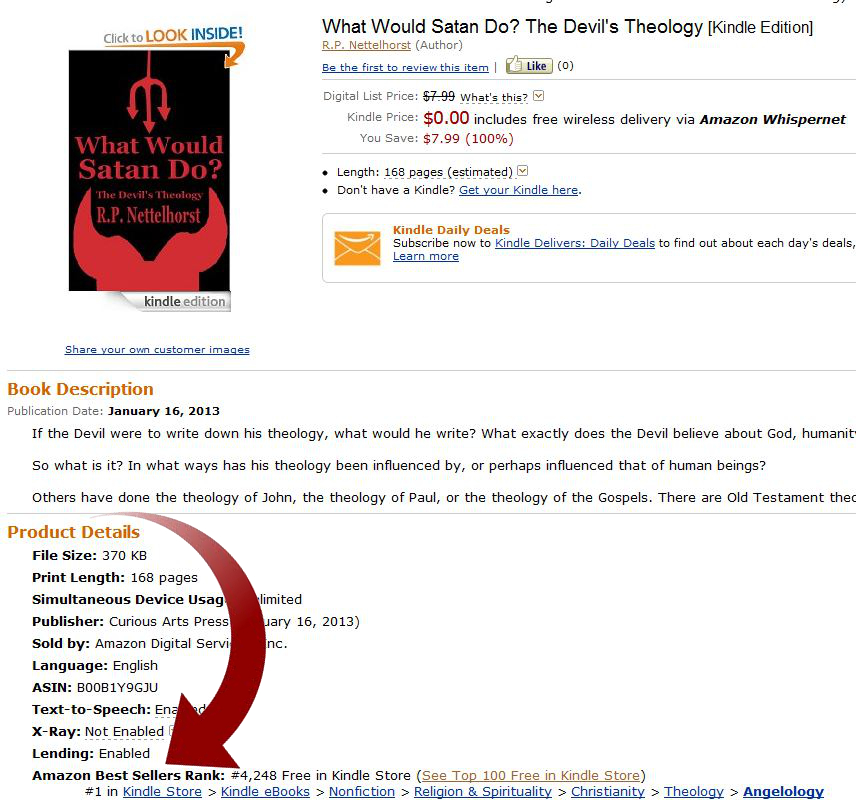
What Would Satan Do? The Devil’s Theology hit #1 for the Kindle today–in an obscure subcategory. At 10:30 Friday night I took at look at the book to see how it was doing–it went on a three day free promotion starting on Friday around midnight:

What Would Satan Do?

As you can see from the screenshot above, the red arrow points to the best seller rank for my book. #1 in an obscure subtopic, but still…NUMBER 1! …in something, anyhow. People going to Amazon and looking for a book on Angelology (doubtless massive hoards) for their Kindle–the first thing they’ll see is my book. And just think, you too can own this bestseller for the utterly amazing low, low price of FREE (through Sunday, January 27–then it returns to its normal price of $7.99; still a bargain).

Send to Kindle
Posted in Writing | Leave a comment

Narrow Gate Now Available

Narrow GateThe novel Narrow Gate is now available for the Kindle. The blurb about the book on Amazon says

Alex Hammond invents a way of linking distant places through a sort of doorway making instantaneous transportation possible. Meanwhile, Steve Cornman leads researchers to a medical breakthrough: immortality.

Powerful forces will stop at nothing to destroy them both.

The novel tells the interlocking story of two inventions: instantaneous travel through gates or doorways that link widely separated locations, and a cure for old age and death. Alex’s eventual sister-in-law is involved with the immortality drug. The story has murder, the threat of murder and physical harm, time travel, and a Toyota van that can travel to the moon, among other places.

What Would Satan Do? The Devil's Theology

What Would Satan Do? The Devil’s Theology

In other writing news, my nonfiction book, What Would Satan Do? The Devil’s Theology will be available for FREE from Friday through Sunday (January 25-27).

This is the blurb on Amazon describing What Would Satan Do? The Devil’s Theology:

If the Devil were to write down his theology, what would he write? What exactly does the Devil believe about God, humanity, and sin? What motivates him? What drives his thoughts? He has a point of view. He has a philosophy of life. He has a theology.

So what is it? In what ways has his theology been influenced by, or perhaps influenced that of human beings?

Others have done the theology of John, the theology of Paul, or the theology of the Gospels. There are Old Testament theologies and New Testament Theologies. Here at last is the theology of Satan.

Send to Kindle
Posted in Science Fiction, Writing | Leave a comment

Reunited

In John 20:1-18 we see Jesus and Mary Magdalene reunited in a cemetery. Sometimes when all seems lost, when we’ve given up all hope and don’t even know we can hope, when it seems obviously too late–that’s when God can surprise us the most. Mary Magdalene had been among the early disciples of Jesus, and she had been one of the women who had helped bankroll the ministry of Jesus. She was also among the handful of disciples that had witnessed the crucifixion. Together with some of the other women, she had planned to finish the embalming of Jesus that Joseph of Aramathea had begun late Friday afternoon. Early Sunday morning, together with the women who had agreed to this task, she had been shocked to find that the tomb had been broken into and the body of Jesus apparently stolen. Heartbroken after having seen Jesus die a horrible death, now she couldn’t even care for his body. Crying, beside herself with grief, through her tears she sees a man in the garden around the tombs and confronts him, “Do you know what happened to his body? Did you take him somewhere? Take me to him, please, if you could…”

Then the man looked at her and spoke only her name: “Mary!”

And at that instant, she suddenly recognized him and fell into his arms, clinging to him so as to never let him go again.

Paul writes in 1 Corinthians 15:20-23:

 But Christ has indeed been raised from the dead, the firstfruits of those who have fallen asleep. For since death came through a man, the resurrection of the dead comes also through a man. For as in Adam all die, so in Christ all will be made alive. But each in turn: Christ, the firstfruits; then, when he comes, those who belong to him

Thus, the picture we see in Jesus’ resurrection, the reunion between Jesus and Mary, is a snapshot of what our resurrection will be like. Come the resurrection, we’ll never again have to let anyone go.

Send to Kindle
Posted in Bible, Religion, Theology | Leave a comment

Another Novel

I’m planning on putting up several more of my novels as e-books on the Kindle in the coming months. About four of my novels need only a bit of proofreading before they’ll be ready to go. But I have another handful–perhaps eight or so–that will require more work before I’ll be ready to let them appear in public.

prometheus03aSo I’m nearly done with the proofreading and formatting of my next novel which had the working title, In the Shadow of Prometheus, and before that Prometheus Gate. Neither of those titles appealed to my first reader and frankly, I’ve been dissatisfied with both for quite some while myself. Now I think I have a title that fits the story better: Narrow Gate.

What’s the book about?

Alex Hammond invents a way of linking distant places through a sort of doorway making instantaneous transportation possible. Meanwhile, Steve Cornman leads researchers to a medical breakthrough: immortality. Powerful forces will stop at nothing to destroy both men and their projects.

I expect to release the e-book before the end of this week. I’d appreciate comments and/or criticism of the title, book cover design and story summary.

Send to Kindle
Posted in Uncategorized | Leave a comment

Leading from Behind

Real leaders don’t try to be the boss.

One day two of Jesus’ disciples, John and James, who also happened to be brothers, got their mom to ask Jesus for good jobs in his kingdom. “Grant that one of these two sons of mine may sit at your right and the other at your left in your kingdom.” (Matthew 20:21).

Jesus denied the request, but unsurprisingly, the other disciples still didn’t take kindly to their attempt. Jesus then turned the event into a learning opportunity, explaining that among Christians, leadership is not what it is out in the world, with bosses lording it over those beneath them. Instead, just as Jesus himself came to serve people and die for them, so those who wish to be great must become servants. The way of leadership in the church is not the way of leadership in the world. Certainly you can take modern business practices and have a well-running, prosperous organization. It’s just that it won’t be doing things the way Jesus wants. Success in the kingdom is not necessarily the same thing as success in the world.

There’s an old story about a young man who wanted to be a minister. Joseph had only recently begun attending the church. One day, he approached his pastor and told him that he believed that God was calling him into the ministry. “I’d like to become a preacher. Is there some job here at the church I could do? Maybe lead a youth group, or teach a Sunday School class?”

The pastor studied the young man’s earnest face and scratched his head, then asked him, “Yes, we do have some jobs here that you could do that would help you learn the ministry. Come with me.”

Excited, Joseph followed the pastor down the hall. The pastor stopped in front of a door, opened it and pulled out a toilet brush. “Here, the bathrooms need to be cleaned.”

Joseph’s eyes went wide. “But I wanted to do something worthwhile.”

“Then you should get to work on those toilets. They’re looking mighty skuzzy.” And he thrust the brush into his hand.

Joseph tossed the brush back into the closet and stormed out of the building, never to be seen again.

“Well, I’m glad we got that settled,” sighed the pastor.

Send to Kindle
Posted in Bible, Religion, Theology | Leave a comment

The Underserving

Tamar’s was an arranged marriage, set up by Judah for his oldest son, Er. According to the account in Genesis 38, Er was a wicked man and as a consequence, God killed him. The reader is not given any details as to what Er’s misdeeds might have been that made God want him dead. Judah then gave Tamar to his next born son, Onan. According to the law in force at the time, since Er had died childless, Onan’s firstborn son would be counted as Er’s son, and would then inherit all of Er’s property. If, on the other hand, Tamar remained childless, Onan would get to keep Er’s property for himself. Therefore, Onan made certain, whenever he had sex with Tamar, that she would not get pregnant. This greedy behavior attracted God’s wrath as well, and so God killed Onan.

Judah promised Tamar that when his next boy, Shelah, came of age, that he would give her to him. But when the time came, Judah gave Shelah a different wife. Tamar realized that Judah was not likely to fulfill his obligations toward her and so she decided to take matters into her own hand. According to the law, if a brother wouldn’t fulfil his duty to marry the widow of his other brother, then it was the duty of the next nearest relative to do the job. In Tamar’s case, that next nearest relative was Judah himself. His wife had recently died and so she knew it wouldn’t be too difficult to force his hand. She dressed up as a prostitute and then positioned herself along the side of a road she knew Judah would be using. Judah came along, took notice of her, negotiated a price and gave her his staff, cord and seal as security, and then had sex with her. Afterward, Tamar put on her normal garments and went back home to go about her business.

When her pregnancy became known, Judah’s reaction was typical of the era: she’d obviously behaved wrongly and needed to be excecuted. But then Tamar sent him his own staff and cord and seal and told him that she was pregnant by the man those items belonged to. Judah cancelled the execution and announced that she was more righteous than him. He recognized that his behavior had been inappropriate.

For the reader of the story, it is clear that the inequity Tamar’s situation, the injustice she faces on all sides, is the whole point of the story. Judah is perfectly willing to pay a prostitute for sex, but if his daughter-in-law were to engage in prostitution, then that’s deserving of a death penalty? Not quite fair. With this story, the author intends to make his readers reconsider their views about the status of women in society.

Prostitution in the Bible is not put forward as a profession to be chosen, but it is inescapable that prostitutes play important roles. Judah treats his daughter-in-law as a prostitute, but she is described then as righteous; and one of the twins born as a consequence of her encounter with her father-in-law is an ancestor of David. A prostitute, Rahab, hundreds of years later will save the Israelite spies, thus helping the Israelites in their conquest of the Promised Land. Then in the New Testament, during the life of Christ prostitutes and other “damaged” women will play significant and pivotal roles. It is the underdogs, the downtrodden of society, those who suffer the worst of life, that God seems very concerned about. He uses them often to serve him and do great things. God does not restrict himself to those who,from a human point of view, seem more honorable and “deserving.” The undeserving are the ones on whom God pours his grace. The concept of favoritism, of treating some better than others because of their social status, their wealth, or any other reason, comes to be rejected by the early Christian community.

Send to Kindle
Posted in Bible, Religion, Theology | Leave a comment

Not Even Wrong

I recently saw a rather ignorant and twisted summary of Christianity from an atheist cartoon. It ended with this: “Eventually, the all-knowing man in the sky got fed up with the people doing things he knew they were going to do that would piss him off, so he takes his son and nails him to a cross, and says, ‘See? Now Look what you made me do. You should be ashamed of yourselves.’”

Kind of misses what really happened. Reminds me of something the physicist Wolfgang Pauli is quoted as saying. Rudolf Peierls writes that “a friend showed Pauli the paper of a young physicist which he suspected was not of great value but on which he wanted Pauli’s views. Pauli remarked sadly, ‘It is not even wrong.'” Generally speaking in science nowadays it is applied to pseudoscience, crackpot theories, and theories that cannot be falsified. I’m twisting it a bit here to mean that the statement or argument is so wrong that it’s hard to track back to where it went off into crazyland.

The cartoon kind of misses the whole point so badly that it’s hard to respond to; that is, one must track back and undo a bunch of odd preconceptions and then insert new ones. It would take a long time to correct all the wrong-headed notions.

So, here’s a short version. Jesus’ death was not designed to shame the human race. It was designed to rescue it. Jesus died for our sins and it was a voluntary act on his part, not forced on him by a vengeful Father. As an analogy to sort of explain it, think in terms of a soldier throwing himself on a grenade to save his buddies, or maybe a fireman who dies saving a family from a burning building.

The details of the crucifixion of Jesus are unpleasant: how he was beaten and humiliated, and finally nailed to a Roman cross to experience a slow and painful death. In fact, the cross was not even a Roman invention. They’d borrowed the idea from the Persians who had invented it as a means of killing criminals as slowly and as painfully as possible. Sometimes it could take nearly a week for a miscreant to finally reach room temperature.

The Romans, who adopted this execution method adopted it for the same reasons that the Persians had invented it: it was public, it was grueling, and it served as a useful warning to others who might think of getting out of line. The Romans believed crucifixion was a useful deterrent to future bad behavior, especially those who might be thinking of rebelling against Roman hegemony. Rebellious sorts were, the Romans believed, likely to think twice before they would take up arms against the Roman state when they saw the highways lined by the writhing bodies of their colleagues.

Jesus was executed by the Romans for the crime of rebellion: they saw him as a threat to civil order, as someone who might attempt to lead a Jewish revolt against Roman control.

Jesus’ disciples also initially saw his death as the end of the line: the smashing of their dreams that Jesus was the Messiah who would overthrow the Romans and re-establish the old Davidic monarchy. It was only Jesus’ resurrection three days later that began the process of forcing them to re-evaluate what they thought they knew about the Messiah and what it was that Jesus had actually been all about. Just as God had rescued the Israelites from physical slavery when Moses led them from Egypt, so now God had rescued them from spiritual slavery when Jesus died and rose again.

The problem with the cartoon summary of Christianity by the atheist is that it misses both the motivation of the actors and the outcome of the story (among other things; missing the resurrection is a serious flaw). Just as a flatearther is woefully ignorant of science, so this atheist is woefully ignorant of Christianity and the Bible.

Send to Kindle
Posted in Bible, Religion, Theology | Leave a comment

Being Quoted as an “Expert”

On Tuesday I happened to get an email requesting “Bible experts” for an ongoing series of articles on the Bible and such, so I responded to the request. Billy Hallowell, Faith Editor/Assistant Editor of The Blaze then contacted me. He wrote,

Thanks so much for your participation! I will be relying upon you as a source for our ongoing Bible series. The first preview story relies upon getting your response to the following news story. Can you send a response by noon ET tomorrow? Thanks, again. Very glad to have you:

Last week, something very interesting happened. MSNBC’s Lawrence O’Donnell took aim at the Bible. I have included the link here: MSNBC’S LAWRENCE O’DONNELL MOCKS THE BIBLE & URGES OBAMA TO EXCLUDE IT FROM THE INAUGURATION

Laurence O’Donnell, a commentator on MSNBC, the cable news channel, said some nasty and ignorant things about the Bible. If you care to waste nine and a half minutes, you can watch it by clicking on the link above.

I wrote about 1800 words in response and sent it off to Billy Hallowell; today, his article reacting to Lawrence O’Donnell’s ignorant rant appeared and I was quoted extensively. If you’d care to read the article, you can click here: FAITH EXPERTS SKEWER MSNBC’S LAWRENCE O’DONNELL OVER HIS ANTI-BIBLE TIRADE: ‘AN IGNORANCE OF OUR HISTORY & DEMOCRACY’

I’m very pleased with how I was quoted. I was also surprised to see that the article has subsequently been reprinted verbatim on several other websites:

Dallas – Faith Experts Skewer MSNBC’s Lawrence O’Donnell Over His Anti-Bible Tirade

Faith Experts Skewer MSNBC’s Lawrence O’Donnell Over His Anti-Bible Tirade: ‘An Ignorance of Our History & Democracy’ — Chris Jones Media

Faith Experts Skewer MSNBC’s Lawrence O’Donnell Over His Anti-Bible Tirade: ‘An Ignorance of Our History & Democracy’

FAITH EXPERTS SKEWER MSNBC’S LAWRENCE O’DONNELL OVER HIS ANTI-BIBLE TIRADE: ‘AN IGNORANCE OF OUR HISTORY & DEMOCRACY’ | “I Am Not Ashamed Of The Gospel Of Christ”

As to who Laurence O’Donnell is. Besides being the Senior Analyst at MSNBC and having been associated with the channel since its inception, he was the executive producer of the TV series, West Wing, has done quite a bit of acting, having appeared in such series as Monk, West Wing, and The Practice. He won two Emmys for West Wing. See his full IMDB Profile.

Send to Kindle
Posted in Bible, Religion, Theology | Leave a comment

Why Am I Here?

My favorite book in the Bible is Ecclesiastes. Many people will think that is peculiar. Perhaps my attraction to that particular section of the Bible has something to do with my personality, or perhaps it’s due to the out-of-placeness and genuine weirdness of the book. Of all the books of the Bible, it seems to be hardest (next to Revelation) for people to make sense of. It is rarely a book people will approach when they need comfort.

But the book of Ecclesiastes is actually very useful for putting life in perspective, and for handling crisis. The book of Ecclesiastes faces some of the biggest questions that people have: does my life really have any purpose? Why am I here? What should I be doing? The author of Ecclesiastes is a long philosophical essay. The author builds his argument, step by step, leading toward his inevitable conclusion. To make sense of it, Ecclesiastes must be read as a whole. Of all the books of the Bible, it is perhaps the easiest to miss its point and to take statements from it out of context and run in the wrong direction.

The author’s purpose in Ecclesiastes is relatively straightforward: he wants to discover, by way of experiment, what the purpose of a human life might be. His presupposition is that all we know of the workings of the universe comes from our own efforts, experience and learning. He assumes that God is silent and inscrutablee.

The author’s conclusion, when all is said and done, is that God is powerful, he does what as he pleases, and it’s impossible for any human being to figure out what he expects from us, since good things happen to bad people and bad things to good people. Therefore, the only rational response for a human being to this life is to have a healthy fear of this God and to attempt to act with as much wisdom as possible. The author of Ecclesiastes believes that wisdom may improve one’s chances of a happy life, but there are no guarantees. In the end, no matter what you do, whether you’re good or bad, wise or foolish, God is going to get you: you will die. Life, when all has been examined, is essentially absurd and futile.

Ecclesiastes takes a very existential view of life.

However, Ecclesiastes is true only as far as it goes, and only given the author’s pressupositions: if God has never talked to people and told them what he wants and what he thinks about them, then life is absurd and ultimately meaningless. But if that presupposition isn’t right, then the essay’s conclusion will be different. What Ecclesiastes does, therefore, is demonstrate the importance of God’s self-disclosure, his revelation to the human race through scripture and Jesus Christ. If all we knew of God was through what theologians call general or natural revelation (as described in Psalm 14: the heaven’s declare the glory of God), our understanding of God could never be more than what the author of Ecclesiastes presents. We’d never know for sure that God loves us and we’d never know what he wants, or what his plans for us might be. Ecclesiastes is a biblical argument for the need of the Bible.

Send to Kindle
Posted in Bible, Religion, Theology | Leave a comment