Happenstance

The universe is random. Despite the more fatalistic branches of Christianity, and other religions, the biblical picture—I believe—is not at odds with our experience of the world. That is, I believe that God has given us freedom, and that freedom is prized greatly by God—so much so that he was willing to let Adam and Eve have the freedom to choose badly: all that has followed that original bad choice on the part of the founders of humanity was worth it from God’s perspective. Otherwise, if goodness, for instance, and behaving well, were what mattered most to God, he would not have granted such freedom to our ancestor and ancestress.

I think likewise, that happenstance is a part of life as well. Sometimes things just happen. Consider the words of God in relation to accidentally killing someone when they hit him:

However, if it is not done intentionally, but God lets it happen, they are to flee to a place I will designate. (Exodus 21:13)

Or:

For instance, a man may go into the forest with his neighbor to cut wood, and as he swings his ax to fell a tree, the head may fly off and hit his neighbor and kill him. That man may flee to one of these cities and save his life. (Deuteronomy 19:5)

Or consider the time when a king was killed by happenstance:

But someone drew his bow at random and hit the king of Israel between the sections of his armor. The king told his chariot driver, “Wheel around and get me out of the fighting. I’ve been wounded.” All day long the battle raged, and the king was propped up in his chariot facing the Arameans. The blood from his wound ran onto the floor of the chariot, and that evening he died. (1 Kings 22:34-35)

It just happened at “random.”

The picture that we get of the world in the Bible is not one of determinism. Instead, people make choices and they are held accountable for those choices. Things may turn out well, or not.

Investing is unpredictable, and how things will turn out for you? Who knows?:

Ship your grain across the sea;
after many days you may receive a return.
Invest in seven ventures, yes, in eight;
you do not know what disaster may come upon the land.
If clouds are full of water,
they pour rain on the earth.
Whether a tree falls to the south or to the north,
in the place where it falls, there it will lie.
Whoever watches the wind will not plant;
whoever looks at the clouds will not reap.
As you do not know the path of the wind,
or how the body is formed in a mother’s womb,
so you cannot understand the work of God,
the Maker of all things.
6Sow your seed in the morning,
and at evening let your hands not be idle,
for you do not know which will succeed,
whether this or that,
or whether both will do equally well. (Ecclesiastes 11:1-6)

And then, this passage seems rather explicit about the randomness of existence:

I have seen something else under the sun:
The race is not to the swift
or the battle to the strong,
nor does food come to the wise
or wealth to the brilliant
or favor to the learned;
but time and chance happen to them all. (Ecclesiastes 9:11)

We are free to make our choices. Our lives are not deterministic.

Send to Kindle
Posted in Bible, Religion, Theology | Leave a comment

Europa

Source SPACE.com: All about our solar system, outer space and exploration.

Send to Kindle
Posted in Science, Space | Leave a comment

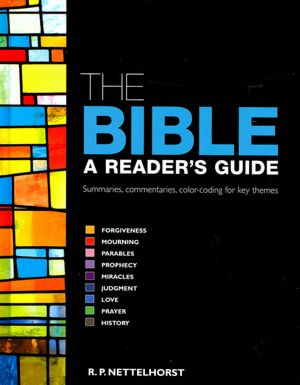
Bible for Dummies

The PC’s For Dummies book and its sequels have sold in excess of forty-five million copies. It has spawned numerous sequels and imitators, ranging from Windows for Dummies to Chess for Dummies and Gardening for Dummies.

The Bible is the best selling book of all time. Yet, as scientific surveys and the unscientific but amusing “Jay Walking” segments on the Tonight Show illustrate, the percentage of Bible owners who know what to do with their Bibles is certainly much lower than the percentage of PC users who are confused by their new machines. Then there are the folks such as Bill Maher and xxxx, not to mention all the internet posters, who pontificate on the Bible as if they know what they are talking about and actually have no clue. So what kind of book could be written that could reach out to them? Currently available Bible handbooks and commentaries are not designed for neophytes and tend to be dry and boring. How-to-read-the-Bible books are designed for people who already have exposure to the Church and to the Bible. Moreover, they fail to answer the sort of questions a new, unchurched Bible reader would have.

Of course, course, there is already a book called The Bible for Dummies. There’s also The Complete Idiot’s Guide to the Bible. So perhaps what I have in mind has already been taken care of–except when I look through them, they strike me as being essentially the sort of guides to the Bible that are made for people who already have some idea about what’s going on in it.

I’m thinking of something more for the Bill Mahers or the average person who has never even looked through one before and all he knows about it is what he hears from people around him. I’m thinking for the equivalent of a high school freshman confronted by a Shakespeare play for the first time. He doesn’t know anything about how plays are written or staged, Elizabethan English is beyond him, and he’s barely heard the word Shakespeare before. Now he’s being forced to make sense of Macbeth.

I wonder if there’s a market for an owner’s manual for the Bible for people who may own the book but have no clue what to do with it and who have little if any exposure to the church or Christianity.

I’ve thought of some of the kinds of questions that might need to be answered:

Why are all the sentences numbered?
Does the Bible have an answer for every question in life?
What’s the plot?
How do I find my way around it, keep from getting lost, and make sense of any of it?
Does owning a Bible make me better than other people who don’t?
Who are the Gideons and why do they put the Bible in hotel rooms?
Who the heck is Habakkuk and what in the world is he talking about?
Should I upgrade to a modern translation? Which one?
Why are the names in the Bible so odd and hard to pronounce?
Why are there long lists of these ridiculous names linked together with the odd word “begot”?
Who wrote the Bible?
Why should anyone pay attention to what the Bible says?

Send to Kindle
Posted in Bible | Leave a comment

Yay for Modern Medicine!

Something that I don’t understand is the reluctance some people to use modern medicine. I’ve just been reading the biography, Steve Jobs by Walter Isaacson. He was diagnosed with pancreatic cancer in 2003 and for nine months he refused to follow the advice of his doctors to get an operation and to have chemotherapy. Instead, he tried taking herbs and vitamins and eating vegan and the like. As a result, when he finally consented, the cancer had spread beyond the pancreas, into his liver. Later he needed a liver transplant, but the cancer was still in his body. And so he died at 56. Had he gotten modern medical treatment as soon as the disease was first diagnosed, rather than waiting nine months, his chances of survival would have been much better.

I read recently online from people who don’t like modern medicine. One of them wrote that that they had suffered from depression and still do. This person was proud of the fact that they just ate healthy and took herbs and vitamins–and had been off medication for years. But they admitted that the depression was still there, no better than it had been.

The resistance to medication is especially prevalent for mental illnesses; there is the thought that if you just get the right diet—or maybe pray, or have a better relationship with God, or just trust in God, that all will be well. Your illness will go away—and if not, well, it’s just God’s will and perhaps you haven’t prayed hard enough or maybe you need better vitamins or to change your diet. Or maybe it’s just because you’re an awful sinner.

My eighty year old father developed lung cancer. He had never smoked a day in his life; no way of knowing why he got that form of cancer. Cancer doesn’t even run in our family. He faced the grueling regimen of chemotherapy and radiation. His hair fell out. He had trouble eating. He suffered quite a bit. But in the end, the cancer went away. Now, two years later he just had a chest x-ray–my mom called today to tell me–and so he remains cancer-free, healthy and active.

My pastor had to go through the same process for his breast cancer—with the same result. It was grueling, but in the end, he is now cancer free and has returned to swimming and cycling and of course still preaches every Sunday.

I know people who have to take medication every day for ailments such a rheumatoid arthritis; without their medication, they would be crippled and in severe pain. With the medication, they lead normal lives.

I suffer severe allergies. Until my allergist found the right combination of anti-histamines, I suffered extremely almost year round with pollen allergies; on top of that, I have asthma. Without my various medications, I would still be suffering, or perhaps dead, since asthma is life-threatening and people die from it every year. I have to take several types of medication every day for my allergies and asthma. It keeps me well. In fact, thanks to my medication, I have no symptoms of my allergies or asthma at all. No sneezing, no hacking, no runny noise and eyes, no gasping for breath. I don’t mind taking the medication that keeps me feeling normal. Why should taking such medication ever bother me? Why would taking special herbs or vitamins every day be better for me (especially since it wouldn’t work)?

Likewise, both my parents have high blood pressure. Their parents had high blood pressure. My grandparents didn’t follow their doctors’ advice; they didn’t take their blood pressure medication—and they died of a series of strokes: first partial paralysis on one side, followed by another stroke that caused dementia, and then another after that that was fatal. All preventable by taking blood pressure medication.

I take my blood pressure medication every day, just as my parents do. Why should that bother me?

I suffer from dysthymia, a mild form of depression. I take medication for that. It works. Why should I go off my medication and become proud of that, but return to being depressed? Makes no sense.

Why prefer herbs and vitamins over medicine? Because it’s natural? So’s disease. So’s arsenic. So’s poison oak. It doesn’t make it better than medication that we know works. Our ancestors ate diets free of all the things that those who insist on “natural” fear—and they didn’t live as long as we do and they suffered more disease. They had no way to cure diseases that we today can fix easily—or with difficulty.

God made human beings intelligent. He gave us tools and curiosity. We’ve made tremendous strides in medical science as a result of the intelligence and talent that God has provided people. If he didn’t want us to be intelligent, to use our minds, to solve puzzles and problems, then why did he make us so smart? I believe the rejection of modern medicine on the part of some Christians is a rejection of God’s gift.

Oh, and those who go on about how the big pharmaceutical companies make huge profits and they are only in it for the money. Like the health food, vitamin and herb manufacturers and sellers aren’t? That’s a really silly argument.

Medicine works. Doctors work. If you’re in a car accident and are seriously injured, who you going to go to? Your health food store or a doctor? If your baby has a high fever and is screaming, are you going to hope herbs will work, or will you rush her to the emergency room?

Human beings today are healthier, longer lived and in all ways better off than our ancestors. Small pox, a scourge through human history has been eradicated thanks to vaccinations. Small pox is extinct! My children didn’t have to get that vaccination.

You like herbs and vitamins and such? That’s your business I suppose. But I think it’s stupid to resist the medicines that actually work.

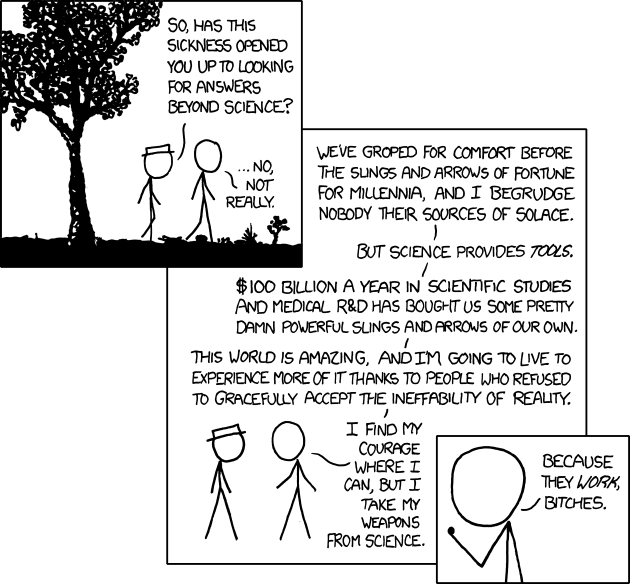
Thus, I really like this XKCD comic:

Send to Kindle
Posted in Religion, Science | Leave a comment

Getting Quoted

Once again I was asked about a topic in the news and then found myself quoted extensively in the resulting article:

DOES THIS BIBLE VERSE CITED BY BILL NYE AND BILL MAHER REALLY PROVE THAT ‘RELIGION IS THE ENEMY OF SCIENCE’?

As I pointed out in my response to the religion editor at The Blaze, I believe that much of the so-called conflict between science and religion is a consequence of ignorance on both sides, with much of it a result of a misreading and misunderstanding of the biblical materials by both the religious and non-religious.

And Nye and Maher’s criticism of the opening chapter of the Bible misses entirely the purpose and context of Genesis. The book of Genesis has at least three obvious purposes. First, it is a reaction against the prevailing mythology and polytheism that dominated the world of the Ancient Near East. The Babylonian creation epic, known as Enuma Elish, described a battle between the gods and their ultimate decision to create human beings to serve them as slaves. The Babylonian gods include the sun, the moon, Tiamat (translated “the Deep” in Genesis 1:2) and so on.

In Genesis, the sun, moon, and Tiamat appear, but now they are objects devoid of both divinity and personality. They come into existence simply to provide light on the Earth (in the case of the Sun and moon), or in Tiamat’s case, along with the Earth, awaiting God’s words of direction: “Now the earth was formless and empty, darkness was over the surface of the deep, and the Spirit of God was hovering over the waters.” (NIV) The book of Genesis has but one God who creates human beings not as slaves, but as the masters of the world. And so that is the second point made by the creation account: there is only one God, not many gods.

Third, the story of Genesis is designed to demonstrate that the one God worshipped by Israel does not belong to them exclusively. Although the gods of the nations around Israel were usually perceived as national deities, in contrast, the God of Genesis is the God not just of one nation, but of all human beings everywhere—because all human beings everywhere are part of one big family with a common ancestor.

As to Bill Maher, he is welcome to his opinion that religion and science can’t be reconciled, but I think his opinion mostly just illustrates that he doesn’t know what he’s talking about, rather than corresponding to any reality. There are a number of both scientists and theologians who would strongly disagree with him. For instance, Alvin Platinga is the author of Where the Conflict Really Lies: Science, Religion, and Naturalism. He’s a Christian and he’s the O’Brien Professor of Philosophy, at the University of Notre Dame. Francis S. Collins, M.D., Ph.D., is a committed Christian. He also helped to discover the genetic misspellings that cause cystic fibrosis, neurofibromatosis, Huntington’s disease, and a rare form of premature aging called progeria. A pioneer gene hunter, he led the Human Genome Project from 1993 until 2008. For his revolutionary contributions to genetic research, he was awarded the Presidential Medal of Freedom in 2007, and the National Medal of Science in 2009. He is the author of The Language of God: A Scientist Presents Evidence for Belief. John Polkinghorne, KBE, FRS, is one of the world’s leading experts on science and religion. He is a world-class physics professor at Cambridge who then became a priest. He’s the Founding President of the International Society of Science and Religion, and the winner of the Templeton Prize. Polkinghorne is the author of many books, including Living with Hope: A Scientist Looks at Advent, Christmas, & Epiphany and Belief in God in an Age of Science. That’s just three scientists and/or theologians who would disagree with Bill Maher and would seem, by their very existence, to undermine his opinion. There are many, many more people who contradict Maher’s point of view, of course. Doubtless there are some scientists and theologians who might agree with Maher, but I think they’re as wrong as he is–and just as shallow in their understanding of the issues.

Send to Kindle
Posted in Bible, Religion, Science, Theology | Leave a comment

Extraterrestrial Religion

The only people who think that religion will die with the discovery of extraterrestrial intelligence are the nonreligious. The actual surveys of religious believers that have been made find that believers are undisturbed by the concept. They don’t see it as a threat to their religion at all. Quite the contrary. Despite the thought among those who believe that religion is fading practice among humanity, the reality is that over ninety-five percent of the human race retains a belief in the divine. There has been little change in the numbers over the years since that has been measured. Given the long history of humanity and the near universal belief in religion throughout that history, it seems to me that we are likely to find religion is important to the extraterrestrials that we might eventually come across.

So my question is this: what elements of religion will we find common among intelligent species? Is there a universal content to it just as there is to, say, language? All languages are made of morphemes, a limited number of phonemes, a verbal system, nouns, adjectives—even the grammar falls within a certain limited range of possibilities. So for instance, religion when it is analyzed, has certain things in common, regardless of the religion. For instance, the concept of sacrifice is very common. Why? Sacrifice grows from the basic biological requirement that in order to continue living, something else must die. We consume previously living matter, whether we are vegetarians or not. Life lives on death and so the concept of sacrifice—a living being taking the place of another, the shedding of blood in order to placate the gods, or feed them—is widely seen in one form or another in all religions.

So, will the same thing obtain for non-human sentient species elsewhere in the universe? The nature of life is universal, I would expect, and so the concept of sacrifice will probably be universal as well. So does that mean we will find religions out among the stars that bear striking resemblances to Earthly religions? Will those earthly religions then believe that finding an analogous belief system then proves their religion is “true”? Will we see the development of an academic discipline of comparative Christianity, comparative Buddhism, comparative Islam, as a subset of the current academic discipline of comparative religion?

Send to Kindle
Posted in Religion, Science | Leave a comment

The Legend

Luther wrote once that he threw ink at the Devil. When he wrote those words, he was thinking metaphorically about his translation of the New Testament into German that allowed ordinary people to read God’s word for themselves. Over time, many have imagined Luther was speaking literally. The story is now often told that on one dark night, while Luther suffered doubts about his mission, the Devil himself appeared in his study to taunt him— prompting the Reformer to toss an inkwell at the Devil in order to chase him away.

Similar myths and stories about Satan have multiplied over the years. Much of what people imagine they know about the Devil derives more from Hollywood portrayals than it does from the biblical descriptions.

The Zoroastrian belief that there were two gods, one good and one evil with the world as their battleground and humans as their soldiers, has been taken up into much popular thought. Added to that, are Milton’s words from his poem, Paradise Lost, placed in Satan’s mouth that he would “rather rule in Hell than serve in Heaven.” Together, these portrayals create an image of Satan sitting on a throne surrounded by flames and dancing demons, sending armies of his minions out to wreak havoc on the Earth and recruit converts to his cause. Together with Dante’s Inferno, and pre-existing Roman and Greek myths, people imagine a dark and fiery underworld where demons torment the wicked dead in gruesome ways while cackling maniacally.

Meanwhile, other demons sneak about as invisible imps whose joy is fulfilled by creating havoc: giving flat tires and making computers crash at the worst possible moment. The Zoroastrian belief in good and evil angels who pulled on people like children playing tug of war, one on one shoulder whispering encouragement to good behavior, while the other suggests a vile choice, has made its way into television and the daily newspaper comics.

The Bible paints a radically different picture of Satan than what appears in the popular media. In the Bible, Satan remains a relatively minor character, with few lines of dialogue. He is portrayed as a limited being, constrained in his behavior by God. Satan can be in but one place at a time, and his power is dependent more on perception than actual force. Although immortal, intelligent and dangerous, he is to God as a burning match is to a supernova. He roams the Earth and has access to God’s throne. The flames of Hell are his future punishment, not his current address. He is, as it were, out on his own recognizance, but God will someday send the marshals out to lock him away for good (Revelation 20:1, 10).

Satan is portrayed as a real being who talks and struts about (Job 1:7). As a real being, he has real thoughts, real attitudes, and real beliefs. He has a recognizable personality, with goals and desires.

So who is Satan? What does he want? What does he think about life, the universe and everything? What is his philosophy? His world view? His theology?

Everyone has a philosophy, an outlook on life, a theology. It comes with being a thinking being. Some people think about it more than others; some have a clear sense of what they believe and why. For others, it is a bit more nebulous. How clearly has Satan thought about what he believes and why he believes it? I think if nothing else, it would be accurate to say that his view of God is somewhat skewed, though probably broadly orthodox. For instance, he believes in God, he believes in Jesus. He’s met them and talked to them; the existence of God is not something he questions. He knows about angels–after all, he disputed with Michael. He apparently believes the Bible, since he backed down every time Jesus quoted it at him. He knows about sin, Heaven, and Hell. But I doubt Satan has a clear handle on such things as grace, love, and mercy.

Send to Kindle
Posted in Bible, Religion, Theology | Leave a comment

Heisenberg’s Uncertainty

The Heisenberg Uncertainty principle states that for a given subatomic particle, one may know its location or one may know its velocity, but one cannot know both at the same time. While this may seem ridiculous on a macroscopic level (certainly we know both where our car is and how fast it is going at the same time), on the subatomic level, it quite clearly doesn’t obtain. It is a mathematical certainty, as clear and unabiguous as 2 plus 2 equals 4. Even God can’t make it equal 5, and likewise, even God can’t know the location and velocity of subatomic particles. It would be as absurd and contradictory as asking him to make a square circle.

We can know that given a block of uranium 238,in 4.5 billion years (4,500,000,000) half of it will decay to thorium 234 and finally to lead 206. However, we cannot ever say if a given, individual atom will decay in that time.

Encyclopedia Britannica (vol. 5, p. 502, 1984):

It is impossible to predict the instant when any given radioactive atom will disintegrate. But, when enough radioactive atoms are placed together, observation shows that the number of disintegrations per unit time is proportional to the number of radioactive atoms present. The situation is analogous to the death rate among the human population insured by an insurance company. Although it is impossible to predict when a given policy holder will die, the company can count on paying off a certain fraction of beneficiaries every month.

One can know with certainty that in a million flips of a coin, fifty percent of the time, it will come up heads, and fifty percent of the time it will come up tails. But one can never know with any degree of certainty, whether a particular flip will be one or the other. Evil may simply be an inevitable characteristic of any universe, a sort of quantum indeterminancy that cannot be eliminated by any normal means.
Modern physics has been described as “stranger than science fiction”, as the following quotation from Gary Zukov’s now somewhat dated book, The Dancing Wu-Li Masters:

According to the Many World’s theory, whenever a choice is made in the universe between one possible event and another, the universe splits into different branches.

In our hypothetical experiment we decided to throw the switch into the “up” position. When the experiment was performed with the switch in the “up” position it gave us a definite result (a certain number of clicks in each area). However, according to the Many Worlds theory, at the moment that we threw the switch up, the universe split into two branches. In one branch, the experiment was performed with the switch in the “up” position. In the other branch, the experiment was performed with the switch in the “down” position. Who performed the experiment in the second branch? There is a different edition of us in each of the different branches of the universe! Each edition of us is convinced that OUR branch of the universe is the entirety of reality….

…we are led to the Many Worlds theory in which the world continuously is splitting into separate and mutually inaccessible branches, each of which contains different editions of the same actors performing different acts at the same time on different stages which somehow are located in the same place. (The Dancing Wu Li Masters: An Overview of the New Physics. New York: William Morrow and Co, Inc. 1979, pp. 319 and 321)

Not only is this very weird to think about, it could allow for a very peculiar explanation for who the angels and the demons are.

Send to Kindle
Posted in Science | Leave a comment

Nix, Hydra and Wikipedia

Back on June 21, 2006 the International Astronomical Union announced that the two recently discovered moons swinging around Pluto have now been officially named. One is to be called Nix, and the other is to be called Hydra. They join Charon, Pluto’s largest moon, discovered back in 1978. They were discovered by astronomers using the Hubble Space Telescope.

In addition to having some mythological relation to Pluto, the names Nix and Hydra were chosen because their first initials, “N” and “H,” are also the first letters of New Horizons, the NASA spacecraft launched in January 2006 towards the Pluto system. Currently past Neptune and on its way for a rendezvous with Pluto in 2015, the New Horizons spacecraft will make a point of visiting them. The “P” and the “L” in Pluto are similarly significant. The name Pluto was chosen for the ninth planet because it honored the astronomer Percival Lowell, who instigated the search that ultimately resulted in the discovery of Pluto.

Pluto is the Greek God of the underworld, and the new names for these moons are in keeping with who he is. In Greek mythology, Nyx was the goddess of the night and the mother of Charon, the boatsman who ferried souls across the River Styx into the underworld ruled by Pluto. Hydra was a giant, nine-headed monster, the second of the Twelve Labors of Hercules. Slaying Hydra was not easy for Hercules. Every time he chopped off one of the creature’s heads, two quickly sprouted in its place. He finally managed to finish the beast off by calling on his nephew Iolaus for help. Iolaus came up with the idea of using a burning firebrand to cauterize the neck stumps after decapitation. So, as Heracles cut off each head, Iolaus burned the open stump. After much cutting and burning, the hydra was finally terminated.

When I went to Encyclopedia Britannica online to do research on the names—I was not certain about Nix—all I found was an article about the Germanic sprite called Nix. In Germanic mythology, Nix is a water being that is half human, half fish. It lives in a beautiful underwater palace and mingles with humans by assuming a variety of physical forms, usually female. When I read all that, I was puzzled why that would have been chosen for the moon’s name.

But then I went to Wikipedia, which has been criticized by some as inaccurate given its open source nature. Open source means that the articles can be rewritten by anyone who visits the website. But it was at Wikipedia that I found not only information about the mythology, but within hours of the announcement that the moons had names, there was already a nice article about the moon.

Wikipedia made it easier for a casual searcher to learn the fact that Nyx was the Greek goddess of night and thus more likely the source of the name for the moon than the Germanic sprite, given that Hydra and Charon, are associated with Greek myth, not Germanic, and the naming convention for the planets and moons of our solar system requires Greek or Roman names.

The spelling of the German water sprite is with an “i” and of the Greek goddess with a “y.” The International Astronomical Union changed the spelling of the moon to “Nix,” following the Egyptian spelling of the goddess. They did this to avoid confusion with two asteroids that had already been named “Nyx.”

I later discovered that the online version of Encyclopedia Britannica does have an article on the Greek goddess. But one can find it only if one spells the name “Nyx” rather than “Nix.” Wikipedia, by contrast, gives the searcher both articles, regardless of how one has spelled the name in his or her search. It also gives a hyperlink from one to the other.

Frankly, I find Wikipedia very handy most of the time. On controversial topics, especially anything having to do with modern politicians, there is a tendency for their articles to be very biased, inaccurate, and often defaced by those who dislike the given politician. But articles on general topics I’ve found tend to be quite well done. And the editors of Wikipedia work tirelessly to try to correct and fix any errors that do show up. Additionally, I’ve found that Wikipedia is very quick about keeping articles up to date—somewhat faster than Britannica.

But I still like Britannica, and in general, its articles are more detailed and more thorough. I purchased the book form of the Encyclopedia Britannica shortly after I got married back in the early 1980s. It’s now obviously become a bit out of date, but I’m not planning on replacing it. Instead, I pay for Britannica’s online version, which has all the text of the printed encyclopedia, but is much quicker and easier to use, and is kept constantly up to date. I recommend to my students that they simply subscribe to the online version, rather than purchasing the dead tree version. I also have a version of Britannica that I keep on my , for those times when I need to research something but don’t have access to the web. Wikipedia, of course, has the advantage of being absolutely free. Using multiple sources when doing even initial research is usually a good idea, and encyclopedias are always a good place to start.

Send to Kindle
Posted in Uncategorized | Leave a comment

Bigotry’s Nature

Did you read about the girl, a year or two after the Columbine tragedy, who overheard a boy at lunch talking about his plans to shoot certain teachers and students? She reported what she had heard to the principal. After an investigation, the principal suspended the boy who had made the terrorist threats.

The boy then hired a lawyer who sued the girl for defamation of character. The case was subsequently thrown out, but not before her family had to spend thousands defending themselves against a stupid and frivolous lawsuit. We read such things and perhaps our first reaction is to mutter darkly, “typical lawyer” or to tell the joke, “What are three thousand lawyers at the bottom of the ocean? A good start.”

It has been said that stress is the confusion created when one’s mind overrides the body’s desire to choke the living daylights out of some jerk who richly deserves it. Unfortunately, the all more likely consequence of facing jerks is for us to take the experience and make some wrongheaded and overly generalized conclusions out of it.

If a person of an ethnicity, profession, political party, or religion we have learned to despise does something jerklike we gleefully notice and record it as one more example, and additional, incontrovertible proof, of how bad that ethnicity, profession, party, or religion is. But what if a person who does not belong to the group we hate does the same sort of jerklike thing? What if the person who did it is part of our group? We hardly notice it, then. It makes no lasting impression. That person was just a jerk, we comment. We won’t generalize it to cover all members of the species. We have explanations.

And what if a member of the hated group does something remarkably unjerklike? What if, in fact, they do something that’s actually noble? We shrug. We explain it away. We ignore it. More than likely, we won’t even notice it at all.

The only thing that we’ll notice is evidence that confirms our hatred. We will see what fits our mindset and miss what doesn’t. Every wrong done by the group we despise will enter our brains and take up permanent residence. (This is the same sort of thinking that leads to superstition. You tell me you know someone who broke a chain letter and they keeled over the next day Interesting, perhaps, but that someone died after breaking a chain letter does not prove any cause and effect relationship. It’s like the old joke about the guy wearing garlic to keep the vampires away. “How silly”, we say, but he points out that he hasn’t been bothered by vampires in years.)

If asked to justify our dislike of the group we despise (Republicans, Democrats, lawyers, Muslims, Christians) we’ll easily and cheerfully list all their sins, never considering the obvious fact that given human nature, we could find bad things perpetrated by any group’s collection of jerks that we’d care to name. Even ours. Likewise, we’ll choose not to consider all the good things we could list about a group we dislike. We’ll in fact strenuously argue that we’re right to despise [insert name here] and that there there are hardly any righteous or decent or intelligent ones out there and so we’re justified in our prejudice just because.

This is simple human nature. We tend to only notice information that meshes with what we already believe to be so. We are quick to believe bad things about our opponents, and slow to believe it about those we love. We are good at rationalization and justification and how it’s different about [insert name here]. We are skeptical of those we hate, credulous of those with whom we agree. We can call this the bigoted mindset.

Send to Kindle
Posted in Uncategorized | Leave a comment