Short Story Fragment

Here’s a fragment of a short story I’m working on:

* * *

Dirt Naps Can Be Lonely
by
R.P. Nettelhorst

“Keep that down,” Hadrian said, pointing a crooked finger at the fire in the fire place. “You’re letting it get too bright.”

Dutifully I pushed some of the logs apart, attempting to weaken the flame. Whether there was significant change or not, I’m not sure, but it seemed to ease Hadrian’s mind.

Does a ghost even have a mind? With no brain, no discernible neurons to be firing or electrical signals to be traced, how could he think? I found it hard to believe he even existed, let alone had consciousness. Like old Scrooge, I thought it more likely he was a bit of undigested potato than a leftover from one of the formerly living.

But Hadrian didn’t take to my doubts, and I was curious, nevertheless. Very curious about how he came to be in his current state. That was the reason he had agreed to huddle near a fire with me, late that cold winter night near the end of January, the wind whistling eerily around the eaves of the house, the drifts piling up along the north wall.

The fire popped like a rifle shot; it seemed to energize the spirit of Hadrian.

“I really don’t know how I came to be dead,” said Hadrian sadly. I’d offered him a cup of coffee, but he pointed out that he couldn’t hold one any too well any longer. “I’ve scoured my memory of that night, trying to think what was different, but nothing reveals itself. As far as I can recollect, it was a perfectly ordinary, perfectly normal night at the college. I recall the lecture I gave — a brilliant exposition, really, on the nature of stellar collapse. I traced the life cycles of the various stars, from dwarfs to blue giants. It was just an introductory lecture you know, and I was only painting pictures in words, giving enough to whet appetites so that the next week we could get into the details. The math is really quite extraordinary…” Hadrian paused again, realizing suddenly that he was rambling.

“What was I talking about?”

“You were going to tell me how you came to be here.”

“Oh yes.” He looked gloomy, then sighed. “I could sure use a stiff drink right about now. That’s the worst thing about not being alive any more — you still have needs, but you can’t satisfy any of them.”

He drummed his fingers on the end table; they made no sound, of course. Which raised the question: how was it that I could hear him talk? After all, if the fingers of a ghost drumming on a table were silent, shouldn’t the flapping of his vocal cords against air molecules be just as silent? There was a lot about the nature of ghosts that didn’t make sense.

“As I was saying, I was teaching my class, and then I finished, and most of the students left; a couple hung around and chatted for awhile. Then I went out to the parking lot, turned on my car, and drove home. I live about five miles from the college. It’s not a bad drive, especially not at night.

“When I got home, there were cars in my driveway and in front of my house. I had to park two houses down, it was that bad.

“I grabbed my briefcase…” he lifted it from the floor beside him. I hadn’t asked him about that, and wondered, now, both what might be inside and how he could be carrying it. Hadrian went on with his story:

“‘I’m home,’ I announced and strode into my living room. It was packed with friends and family. The lights were down, and they all were very somber. They looked up at me with startled expressions, and I saw not a few jaws drop. My wife gasped and nearly fell out of her seat.

“‘What’s going on?’ I asked. ‘Is this a surprise party or something?’

“‘You might say that,’ said Joe. He was a colleague of mine at the college. We’d known each other since we were freshmen. He looked worried — no, not worried — annoyed, or maybe angry.” Hadrian shook his head. “I’m so bad at guessing emotion or describing it.” He sighed, then continued with his story:

“Joe stood up from his chair and approached me, studying my face like it was one of those insects he was always going on about. I took a step back, and then demanded, ‘What’s going on?’

“‘What are you doing here?’ snapped Joe right back at me.

“‘I live here.’

“‘Not any more you don’t.’

“‘What the hell are you talking about?’ I was missing the joke, I was sure.

“‘You’re dead,’ he said, point blank, finally.

“I stared at him, then shook my head. ‘What did I do? Did I offend…’

“‘My husband died on Tuesday!’ wailed my wife. ‘Who or what are you?’

“I stared blankly around the room. These were all my friends, my family, my wife. Yet they acted like they didn’t want me to be there; as if I offended all their sensibilities of right and wrong.

“‘I was afraid of something like this,’ commented Joe. ‘You were always very stubborn, and you never could see the obvious.’

“‘I don’t know what you’re talking about…’

“‘Only you wouldn’t notice your own death. I used to joke that you’d be late for your own funeral. Now it looks like you’ve missed it entirely!’

“I just stared, dumbfounded. What can you say when you get news like that? I had never imagined learning about my own death this way.

“‘There’s only one thing we can do,’ suggested Joe. ‘We’ve got to conduct an exorcism.’

“‘What?’ I babbled.

“‘It’s the only way to get rid of you.’

“‘I thought you were my friends…’ I looked around the room, and then focused on my wife. ‘And you…’

“‘You’re dead,’ she screamed, shaking a finger in my face. ‘I don’t want you around anymore. Remember our vows?’

“‘I’m a guy…’ I began.

“‘Til death do us part.’ She glared at me. ‘So go away.’

“Joe got everyone to assemble around a card table in the living room. My wife brought a couple of candles in from the kitchen and set them down. Someone else had a lighter and got them lit.

“Then Joe made everyone hold hands. Joe was not a priest; in fact, I had always gotten the impression that he didn’t really believe in God at all. But he closed his eyes and began chanting like it was the most natural thing in the world, and everyone joined in. They wouldn’t look at me anymore, and they were chanting, ‘Hadrian go away, Hadrian go away.’ And someone had gotten garlic from the refrigerator and was twirling it over his head like a fool. It broke my heart and it was as annoying as hell, and so after fifteen minutes of weird antics I just wandered out of the room. I didn’t even look back.

“I suppose Joe thinks he’s some sort of hero, now. Last I heard, he was making a good second income off of driving out spooks. Like you can really do that.”

Hadrian looked at me, and I felt somewhat queasy at the notion that there would be no way of ridding myself of this unexpected guest.

“So where’d you go?” I finally asked.

“I went to Joe’s house and tried trashing it. Didn’t work. I don’t know how the poltergeists do it. They say I’m just not concentrating.” Hadrian shrugged.

“So what then?”

“Huh? I just wandered around. Being dead’s a lot less interesting than you might think. For awhile, I comforted myself by planning how I’d get even with them when they all died, but after a year or so I realized, hey — if they’re dead, what more can I do to make them feel bad? And besides, there’s that truism about time healing all wounds.” Hadrian sighed with the weight of the world. “You get over the shock of dying and losing everything, and you’ve got to get on with your life…or death, in this case.” Hadrian chewed his lower lip. “I’ve never been back, there, you know. Some of them may have died by now. God, it’s been over fifty years! But I’m not one to hold a grudge, though I don’t really care to see any of them, either. It’s not like anyone ever tried to look me up. Being dead turns out to be kind of lonely, too. Ghosts are solitary creatures…”

“Your friends, your wife…”

“They got on with their lives. Even ten years after you’re dead, who really gives a rip about you? Dead people are forgotten.” He stared gloomily at his hands. “There’s a lot of bitterness in the afterlife, let me tell you. I think that’s what motivates the poltergeists.”

“They’re just pissed off dead people?”

“Yeah — but they get over it.” He paused. “You know, the teenage years can be rough on anyone.”

I stared, puzzled. But he didn’t clarify. I noticed that the sky was beginning to brighten outside.

“You’re going to have to go soon, aren’t you?”

Hadrian looked out at where I was staring.

“No, not really.”

“But the sun will be up…”

“Do I look like a vampire?”

“But I thought…”

“Everyone thinks that light will kill ghosts or something. Read my lips: I’m dead. D-E-A-D. Understand? You can’t do anything to hurt me.” Then he stretched and yawned. “But it’s quieter at night, and you can scare people easier then.” He grinned at me. “So most of us sleep during the day.”

“You have to sleep?”

“You thought ‘rest in peace’ was just a euphemism?” He chuckled, then stood up. “Thanks for the conversation,” he said. “I’ll see you later; I think I’ll go take a nap.”

And with that, he was gone; and I was alone. At least for a while.

* * *

Who is Hadrian talking to? Where are they? Why is Hadrian talking to this person? I wonder what will happen next?

Send to Kindle
Posted in Writing | Leave a comment

A Special Kind of Stupid

You have to be a special kind of stupid to believe that Hugo Chavez, the now former president of Venezuela, was a good guy. And yet, people who claim to be liberal, who claim to be believers in freedom and tolerance, seem to be very happy to praise the most descipicable tyrants. Of course, it has been this way for a very long while. Hollywood is filled with people such as Michael Moore, Sean Penn, Oliver Stone and others who think that Chavez was a wonderful man who only sought the best for the poor and downtrodden. Somehow, if you say the right sappy words, you can get away with tossing your opponents in prison, prohibit those you dislike from running against you, muzzle the press, install your cronies, and stuff your Swiss bank accounts.

Chavez sided with the Communist dictator Fidel Castro, loved the mullahs of Iran, and couldn’t say a bad word about any of the world’s dictators. Consistently, there are those in Hollywood and elsewhere who turn a blind eye to human rights abuses as long as those committing them say nice words about the poor and say bad things about the US.

These people are a special kind of stupid.

What was Hugo Chavez actually like? Consider this description from Freedom House in 1999:

Hugo Chávez, the coupist paratrooper-turned-politician elected who was elected president in a December 1998 landslide, spent most of 1999 dismantling Venezuela’s political system of checks and balances, ostensibly to destroy a discredited two-party system that for four decades presided over several oil booms but has left four out of five Venezuelans impoverished. Early in the year, Congressional power was gutted, the judiciary was placed under executive branch tutelage, and Chávez’s army colleagues were given a far bigger say in the day-to-day running of the country. A constituent assembly dominated by Chávez followers drafted a new constitution that would make censorship of the press easier, allow a newly strengthened chief executive the right to dissolve congress, and make it possible for Chávez to retain power until 2013. Congress and the Supreme Court were dismissed after Venezuelans approved the new constitution in a national referendum December 15….

Venezuela’s political rights changed from 2 to 4, its civil liberties rating from 3 to 4, and its status from Free to Partly Free, due to the decision of President Hugo Chávez, ratified in a national referendum, to abolish congress and the judiciary, and by his creation of a parallel government of military cronies.

More recent information from Freedom House in 2010:

Freedom House today condemned ongoing efforts by the Venezuelan government to bring criminal charges against the owners of Globovision, the only remaining independent television station in the country. Freedom House called the continuing persecution of the station’s ownership a transparent effort to silence one of the few remaining voices that are willing to criticize the policies of President Hugo Chavez in advance of upcoming parliamentary elections.

Two major shareholders in the private television station have recently come under pressure from the Chavez administration. Co-owner Guillermo Zuloaga was forced to flee the country to avoid arrest on charges many believe to have been fabricated by the government. Additionally, the government took over the bank of another shareholder, Nelson Mezerhane, and threatened to seize Mezerhane’s Globovision shares as part of the bank takeover. Currently in Florida, Mezerhane cannot return to Venezuela without fear of arrest.

“President Chavez’s denial that these actions are politically motivated would be more credible if not for his systematic efforts over the last decade to close the space for independent voices, particularly the voices of those who oppose his policies,” said Paula Schriefer, director of advocacy at Freedom House. “Chavez’s continued intolerance for criticism only serves to further weaken what little is left of Venezuela’s democratic credentials.”

Frank La Rue, special rapporteur at the United Nations for freedom of expression, denounced the “harassment” of Zuloaga and said that the arrest warrant was “politically motivated, aimed solely at silencing Zuloaga.”

Reports of crack-downs on independent media have continually plagued Venezuela during the Chavez administration but have increased in intensity as the opposition prepares for parliamentary elections in September. Venezuela dropped two points this year in Freedom of the Press due to increased violence against journalists and the closing of more than 30 radio and television stations under the controversial Law of Social Responsibility in Radio and Television.

Venezuela is ranked Not Free in Freedom of the Press 2010 and Partly Free in Freedom in the World 2010, Freedom House’s survey of political rights and civil liberties.

Things have not gotten better.

Send to Kindle
Posted in Uncategorized | Leave a comment

Warm Happy Thoughts

Finally, brothers and sisters, whatever is true, whatever is noble, whatever is right, whatever is pure, whatever is lovely, whatever is admirable—if anything is excellent or praiseworthy—think about such things. Whatever you have learned or received or heard from me, or seen in me—put it into practice. And the God of peace will be with you. (Philippians 4:8-9)

Happiness is a warm puppy.

Happiness if finding someone you like at the front door.

Happiness is getting together with your friends.

Happiness is the hiccups…after they’ve gone away.

Happiness is a fuzzy sweater.

Happiness is finding the little piece with the pink edge and part of the sky and the top of the sailboat.

Happiness is walking in the grass in your bare feet.

I happened to think of the phrase tonight, “Happiness is a Warm Puppy”. It is the title of a little book by Charles Shultz, the cartoonist who did Peanuts. The book is illustrated with the various Peanuts’ characters, Linus, Charlie Brown, Snoopy, Lucy, and the like, acting out these little phrases, each of which begins, “Happiness is…” It fits with the thought I had that each day has joy in it, if we only look for it: that in the midst of even the worst things, there are things to be thankful for, or things that can give us pleasure, and usually those things are simple things, like walking in the grass, or eating an ice cream cone, or getting a cup of Starbuck’s coffee, or watching a bird whistling on a branch.

Hear my voice when I call, O LORD; be merciful to me and answer me.
My heart says of you, “Seek his face!” Your face, LORD, I will seek.
Do not hide your face from me, do not turn your servant away in anger; you have been my helper. Do not reject me or forsake me, O God my Savior.
Though my father and mother forsake me, the LORD will receive me.
Teach me your way, O LORD; lead me in a straight path because of my oppressors.
Do not turn me over to the desire of my foes, for false witnesses rise up against me, breathing out violence.
I am still confident of this: I will see the goodness of the LORD in the land of the living.
Wait for the LORD; be strong and take heart and wait for the LORD.
(Psalm 27)

Send to Kindle
Posted in Bible, Quotes, Religion, Theology | Leave a comment

See the Comet

This is the first of two bright comets that we’ll get to see this year. It should be easy to see after sunset starting Sunday or so. The prediction is that it will get as bright as the North Star, but comets are fickle things, so it might be better or worse. We’ll have to wait and see.

Source SPACE.com: All about our solar system, outer space and exploration

Send to Kindle
Posted in Science, Space | Leave a comment

The Bible: Thoughts on the History Channel Miniseries

My wife and I managed to watch only the first 20 minutes of the series The Bible, on the History Channel. We found the acting poor and overdone; the cultural and historical setting and background were lacking, and the behavior of the characters was unrealistic to the point of making them seem to be weirdos. It was, simply, a rather typical bad Hollywood attempt at portraying the Bible stories.

I’m trying to figure out why the overwhelming majority of attempts to film the stories of the Bible simply don’t work–to the point that I really can’t think of any that do. I can think of at least four things that make doing a film of the Bible hard:

1. The film makers are desperately trying please everyone and offend no one. It reminds me of the Aesop fable about the man, the boy and the donkey:

A Man and his son were once going with their Donkey to market. As they were walking along by its side a countryman passed them and said: “You fools, what is a Donkey for but to ride upon?”

So the Man put the Boy on the Donkey and they went on their way. But soon they passed a group of men, one of whom said: “See that lazy youngster, he lets his father walk while he rides.”

So the Man ordered his Boy to get off, and got on himself. But they hadn’t gone far when they passed two women, one of whom said to the other: “Shame on that lazy lout to let his poor little son trudge along.”

Well, the Man didn’t know what to do, but at last he took his Boy up before him on the Donkey. By this time they had come to the town, and the passers-by began to jeer and point at them. The Man stopped and asked what they were scoffing at. The men said: “Aren’t you ashamed of yourself for overloading that poor donkey of yours and your hulking son?”

The Man and Boy got off and tried to think what to do. They thought and they thought, till at last they cut down a pole, tied the donkey’s feet to it, and raised the pole and the donkey to their shoulders. They went along amid the laughter of all who met them till they came to Market Bridge, when the Donkey, getting one of his feet loose, kicked out and caused the Boy to drop his end of the pole. In the struggle the Donkey fell over the bridge, and his fore-feet being tied together he was drowned.

“That will teach you,” said an old man who had followed them:

“Please all, and you will please none.”

Thus, because there are so many factions and points of view to try to please when crafting a movie, because there is so much money involved, because there are so many advertisers (in the case of something made for TV), and because there is so much fear that some group or church will object to something, all that can come out is soft pablum. It’s not particularly offensive, except for wasting my time, dragging, being boring, and being bereft of any real entertainment value. But few constituencies are likely to picket the studio or write nasty letters to the advertisers because of anything that shows up on screen.

2. People in general, Christian and not, tend to have a poor idea of what the Bible is really about, since most of them have barely read even parts of it. Worse, they approach the Bible naively, imagining that the people and events described would somehow not be out of place among the most stiff, staid and stuck-up Puritans in Massachusetts. If anything doesn’t fit the conception of what true holiness and righteousness are, then the stories must be forced to fit that straight-jacket. Reminds me of the story about the little girl in Sunday School. Her teacher said, “Children, what has gray fur, a big puffy tail, and hides nuts for the winter.” The child raised her hand and burst out: “It sounds like a squirrel, but I know the answer has to be Jesus!”

3. The complexities and cultural differences of the Ancient World are simply hard to film; how, for instance, would a film maker explain that taking a second wife to bear a son for the first wife was normal in the culture of the Ancient Near East in which Abraham lived? Let alone all the other peculiar customs and laws and regulations? How does a film maker create the sense of the out-of-placeness of the biblical world as compared to the modern world–not just horses and camels and tents– but the whole alienness of how those people lived, interacted, and conducted business. They have no concept of democracy, western ideals, precision, or punctuality. Just a small example: when we hear the word “earth” we picture a blue ball spinning in space. No one in the Bible would ever picture that; for them, “earth” is the land they live on, that they can see around them out to the horizon–it is what is not wet, like the sea.

4. Because they are Bible stories, there is a great reluctance to recognize that the characters in the story are complex; they are something other than the most pious, upright and noble beings ever. Instead, they really are just ordinary men and women doing they best they can; they make mistakes, they do bad things, they doubt, suffer disappointment–even though they are the good guys and the heroes of the story. Filmmakers, for the reasons listed above, are afraid to portray them as human beings; it is safer for them to make them into the plaster saints that so many expect.

I do not think it is impossible to do a dramatization of the biblical stories; they are great stories. But I do think it would be impossible to do it without offending a lot of people. And given that TV and movie making is about making money–and you don’t make money if you offend too much of your audience–I’m not sure it will ever change.

Send to Kindle
Posted in Bible, Culture, Religion, Theology | Leave a comment

Life

Sometimes it is hard to get up in the morning. And sometimes it’s hard to go to sleep at night. It’s easy to identify with the words of Deuteronomy 28:66-67:

You will live in constant suspense, filled with dread both night and day, never sure of your life. In the morning you will say, “If only it were evening!” and in the evening, “If only it were morning!”—because of the terror that will fill your hearts and the sights that your eyes will see.

I especially could identify with that when our foster son died of SIDS 15 years ago and we were sued for 31 million dollars for wrongful death. It was hard to sleep and it was hard to get up. It was hard to do anything at all, in fact.

That’s what the problems in our lives can do to us: they paralyze us and make it hard to function. We know we should read our Bibles, we know we should pray, but when we do either thing, it feels empty. We don’t know what to say to God and we don’t feel much like talking, any more than we feel like getting up out of our chair. Those things that once brought us pleasure, that once made us excited, now seem empty and do nothing for us at all. When we read the Bible—or anything else for that matter—we can read the same paragraph over and over again and get nothing from it. Watching TV or a movie is an empty experience; we may find it hard to even remember what we just saw on the screen.

Jesus told an audience, “Therefore I tell you, do not worry about your life, what you will eat or drink; or about your body, what you will wear. Is not life more important than food, and the body more important than clothes?” (Matthew 6:25)

Jesus told his disciples, not long before he was arrested, convicted, and executed, “Peace I leave with you; my peace I give you. I do not give to you as the world gives. Do not let your hearts be troubled and do not be afraid.” (John 14:27) Sometimes people give us encouragement in the middle of our bad times and we think “easy for you to say.” But given Jesus’ context, knowing what he was about to face, his words carry added force. They were not easy, they were not cliché, and they were not flippant. He believed them even though he faced the ultimate crisis.

Send to Kindle
Posted in Bible, Religion, Theology | Leave a comment

An Excerpt

John of the Apocalypse

John of the Apocalypse

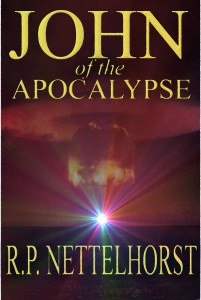
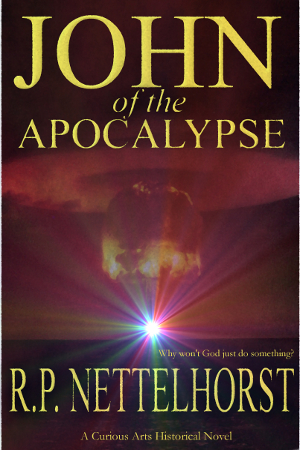
An excerpt from my novel, John of the Apocalypse, available as an e-book for the Kindle:
* * *

“So what was that last thing you heard Jesus say?” demanded Albertus. “I wish you’d stick with Greek, you know; or have you noticed? You’re the only Jew here.”

John frowned. “Yeah, I’ve noticed.” He paused. It means, “My God, my God, why have you forsaken me?”

Lydia’s eyes brightened. “Oh, I’ve heard that before; why would he have said such a thing?”

“I heard someone tell me it signified that when God put all the sins of the world on Jesus, that God turned his back on him, that for the first time ever, Jesus was separated from his Father…” began Eusebius.

John laughed, a bitter, derisive sort of laugh. “What a load of B.S,” he commented, then frowned, when he noticed the shocked look that Lydia gave him. As if she had never heard such language before. Of course, she wasn’t a fisherman, was she?

“Excuse me…” she began.

“He’d been betrayed by one of his closest friends, and all the rest of them had run away. He had been beaten nearly to death with a whip, he’d had a crown made out of thorns pushed onto his scalp, he’d been kicked, he’d had his beard and hair plucked out by the roots, he’d been spit on and mocked and then finally nailed naked to a cross and left to die a slow and miserable death. What the hell would you have expected him to say, huh? ‘Oh praise you God, for this great and marvelous blessing?!’”

“Well, he is God’s Son, you know…” began Lydia.

“He was a man!” shouted John, loudly. “Don’t you freaking get it? Jesus was a human being, just like you, just like your husband, just like me.” He could feel his nostrils flaring, his heart was thumping; he wanted to get control of himself again, but the words just kept coming. “How did you respond when you were beaten? You were ready to sacrifice to the great god Domitian, weren’t you?”

Eusebius swallowed.

“But he was God…” began Lydia.

“Tell me Eusebius, did you think that Domitian was divine?”

He shook his head.

“Did you have any doubt about who Jesus was? Had you begun to question the rightness of your cause, the certainty of eternal life?”

Eusebius shook his head.

“But you were still going to pour wine on Caesar’s altar.”

He nodded, bowed his head, started to shake.

“But he was God!” insisted Lydia.

“He was a man; and he died like men die when they’re on a cross, when they’ve been beaten: he was in agony, he was worn out, and he was alone. Everyone had abandoned him, and now he was just dying there, and nothing was happening, and life was going on without him, and tomorrow he was going to be dead, but everyone else would still be there. The sky was dark, no dove descended from the sky, no words shook the earth announcing that “this is my Son, in whom I’m well pleased.” He was stuck on that Roman cross, and three women and one friend stood there helplessly and watched him die and there wasn’t a thing any of us could do to help him, to make him feel better, to make the pain go away.” John sobbed. “And so he just died, alone, abandoned, and hopelessly.”

“But he was God.”

“He died by himself, killed by the enemies of God. What the hell else was he going to say, huh?”

“But how could Jesus feel despair?” asked Lydia.

“How could he not?” asked John. “He was a human being; he had the same feelings, the same hopes, the same needs that all the rest of us have. Sure he was God, is God—since he lives again—but he was human, and that meant all the things it means for us to be human. He never screwed up like the rest of us, but otherwise, he felt what we feel: he was sad, he was happy, he was angry, he was scared, he felt lonely and he felt despair.” John shook his head. “Why are you Greeks so loathe to admit that there’s nothing wrong with being made of flesh?” He picked up his cup, looked at it, rubbed his fingers on the smooth sides of the ceramic bowl. “God created us to be like we are: to sweat, to get tired, to make love, to touch and feel, to laugh and cry. This cup contains wine, and the wine makes me feel good; I like the taste, I savor the experience, I wallow in it; I live my life fully, and rejoice in what I feel, what I taste, what I see, what I touch. The world around us is full of pleasures, of satisfactions, of enjoyment, and it is there to be enjoyed.”

“How Epicurean…” commented Lydia.

John ignored her, went on. “There is no virtue in denying your senses, in pretending that you don’t feel; no virtue attaches to you from seeking discomfort instead of pleasure. You are not any closer to God, you are not any more spiritual when you refrain from anything that might be fun. Why is the sun warm, the air filled with the smell of sweet flowers, the grass green, the water wet? Why is there wine, and bread and fruit? Do you cringe from pain? Why does the noxious, the painful, the ugly and the uncomfortable make you flinch away? Why are you attracted to the pleasant, the sweet, the warm, the loving, the happy? Jesus was human like that. He loved life; he felt life. He experienced the full range of emotions.” John paused. “And you know what? We human beings were created in God’s image; we’re just like him, the lot of us. So feeling, being alive—these were not new experiences to Jesus; God knew those feelings; God has those feelings. Feelings—they’re not an evil thing. They simply are, like the blue in the sky, or the wet in water. You seem bothered by Jesus’ cry of despair when he died.” John paused, shrugged his shoulders. “I’d be bothered only if he hadn’t.”

Send to Kindle
Posted in Bible, Culture, History, Religion, Theology, Writing | Leave a comment

More About Economics

Banking and investments seem impossibly mysterious to many people who have trouble just getting their checkbook to balance.

Let’s begin by looking at what’s called the “money supply.” The money supply is the total amount of money available to the economy at any particular moment. What is money? It’s more than just the metal slugs and slips of green paper in your pocket. Money is simply anything that can be used to settle a debt.

How is the money supply measured? There are four ways of measuring it, referred to as the M0, M1, M2 and M3. M0 money is physical currency: the coins and green paper you carry around–that is, the money in actual circulation–and the cash assets held in a central bank.

M1 money includes the stuff of M0 with the addition of money in “demand accounts”–that is, checking accounts. M1 is the measure that economists use to quantify the amount of money that is in actual circulation.

M2 is made up of everything in M1, with the addition of time deposits (those things like Certificates of Deposit that you can’t access for a specific period of time), savings deposits, and non-institutional money-market funds. Economists use M2 when they are trying to predict inflation.

M3 is made up of everything in M2 and includes large time deposits, institutional money-market funds, short-term repurchase agreements, and other larger liquid assets. It is used by economists when they want to measure the entire supply of money within an economy.

These different sorts of money that exist in the money supply statistics arise from the practice known as fractional-reserve banking.

What’s that?

When a bank gives out a loan, money is actually created by the bank. If you deposit a hundred dollars into the bank, they lend it out ten times with a fractional-reserve rate of twenty percent. This means that of the initial one hundred dollars, twenty percent of it, or twenty bucks, is set aside and kept in the vault, while the remaining eighty percent, or eighty bucks, is loaned out. The recipient of the eighty dollars then spends that money. The receiver of that eighty dollars then deposits it into a bank. The bank then sets aside twenty percent of that eighty dollars, or sixteen dollars, as reserves and lends out the remaining sixty-four dollars. As the process continues, more commercial bank money is created, since the bank only is keeping as a reserve twenty percent of any of the money given to it. The rest it loans out. That’s how the bank makes money on the money you put into it. Otherwise, the bank would have to charge you for holding on to your money. This creation of money by this means inflates the money supply. If the economy grows to match the increase in this money supply, then wages and prices remain stable. If things get out of balance, then you get “inflation.”

The banks lend the money at an interest rate based on how much it costs them to get the money they are lending out, and based on the amount of risk they are taking in making the loan: if banks and other lenders are careful, then they will receive back more money than they lent out, thus making a profit and allowing them to continue lending money. If they are not careful, then they can wind up in a situation where they do not have enough funds to lend any more money, or worse, cannot repay those who have deposited money into the bank.

If you recall the movie A Wonderful Life, when the depression hits and people panic, creating a “run” on the bank, George Baily calms the situation by pointing out that the money the people in his town have put in his Savings and Loan is not in the vault–it’s been lent out to their friends and neighbors: “it’s in Joe’s house.”

This fractional-reserve banking works because over any typical period of time, demands by people to take the money out of the bank–redemption demands– are for the most part offset by new deposits or issues of notes. The bank thus needs only to satisfy the excess amount of redemptions. Second, only a minority of people will actually choose to withdraw their demand deposits or present their notes for payment at any given time. Third, most people keep their funds in the bank for a prolonged period of time. And finally, banks usually keep enough cash reserves in the bank to handle all the demands for cash.

If the demands for cash are unusually large, however, the bank will run low on reserves and will be forced to raise new funds from additional borrowings (that is, by borrowing from the money market or by using lines of credit held with other banks), and/or sell assets, to avoid running out of reserves and defaulting on its obligations. If creditors are afraid that the bank is running out of cash, they have an incentive to redeem their deposits as soon as possible, triggering a bank run.

Bank runs are very unusual today, largely because of the systems set in place following the Great Depression, such as deposit insurance and the current requirements now of how much of a reserve banks must keep. The interest rates that we pay or get for our deposits are determined to a large extent by how much banks charge other banks for the money they lend to each other. The government sets the interest rate that banks charge one another. The decision on what rate to charge is based on how well the economy as a whole is doing. If it isn’t doing well, or if there is a fear that it won’t, the rate will be lowered: that will put more money into circulation. If there is a fear that inflation may be in the works, the interest rate will be raised, thus lessoning the money supply.

How does the stock market work into all of this? It is simply a public market for the buying and selling of securities–that is a percentage shares–in businesses. It is a way for businesses to raise money that they can then use to expand; if the business is successful, they will make a profit, which will allow them to pay back all the people who purchased a percentage of the company, or if people keep the stock, then those share holders will receive a percentage of the profit as a dividend payment. People may buy and sell shares of the company at any time, however, and the price of a company’s shares will rise or fall based on how well the company is doing, or how well people imagine it is doing.

Send to Kindle
Posted in Uncategorized | Leave a comment

Free Return Trip to Mars

Since they are looking for a married couple to do this, I talked to my wife about it and she’s agreeable. Just have to see where you go about signing up. We get along well–we’ve been married nearly 30 years now–so from the compatibility standpoint it would work. And by 2018 all our children will be adults.

Source SPACE.com: All about our solar system, outer space and exploration

Send to Kindle
Posted in Science, Space, Technology | Leave a comment

Perspective

The heavens declare the glory of God;
the skies proclaim the work of his hands.
— Psalm 19:1

The Earth is 7927 miles in diameter.

The Moon is 2163 miles in diameter, and averages 238,857 miles away from the Earth. This is the equivalent of 1.3 light seconds away. Light travels 186,300 miles per second.

The Sun is 864,000 miles in diameter, more than large enough for the Earth-Moon system to slip inside with room to spare. The Earth is an average of 93 million miles away. This is the equivalent of 8.3 light minutes away — the distance light can travel in 8.3 minutes.

Pluto, the furthest planet from the sun, averages 3.67 billion miles from the Sun. This is the equivalent of 5.5 light hours away.

More than 99 percent of the mass of the solar system is in the Sun, whose mass is 4.385 times 10 to the 30th pounds (4,385,000,000,000,000,000,000,000,000,000,000). This is 333,000 times the mass of the Earth.

The Sun is made of mostly hydrogen gas which is heated by continuous nuclear fusion at the core, where the temperatures are near 27 million degrees Fahrenheit. The visible surface of the Sun has an average temperature of 9950 degrees Fahrenheit and continuously radiates power of 3.85 times 10 to the 26th watts (38,500,000,000,000,000,000,000,000,000) into space. The Earth intercepts less than half of one-billionth of that power.

The Sun is a fairly typical star; most stars range from one tenth to ten times the size of our Sun. Antares, the reddish star in the constellation of Scorpius is five hundred times the size of our Sun. Our Sun and all the planets to the orbit of Mars could easily fit inside it. Antares is 400 light years from Earth.

A light year is the distance that light can travel in one year — about 5.88 trillion miles.

Alpha Centauri is the nearest star to Earth. It is 4.3 light years away — 25,000,000,000,000 miles away. The fastest men have ever traveled in space was 25,000 miles per hour (escaping Earth’s gravity on their way to the moon — which took them three days to reach). It would take 115,340 years to travel to Alpha Centauri at that speed.

Let’s look at these distances another way. Suppose you could drive your car to the Sun, 93 million miles away. At sixty miles an hour it would take you almost one hundred seventy-seven years to get there. Now imagine how long it would take you to get to Alpha Centauri in your car.

In their book, The Planetary System by Morrison and Owen, they write (pages 24-25):

To gain an appreciation of the size of the solar system and the distances between the various planets, we can make use of a scale model. Let’s reduce every dimension in the solar system by a factor of 200 million. On this scale, the Earth is the size of an orange, and our Moon would be a grape, orbiting the orange at a distance of six feet. The Sun would be a little less than half a mile away, and it would have a diameter of twenty-three feet, the height of a two-story building. It is the great distance of the Sun from the Earth that makes it appear to be about the same size as the Moon when we see both of them in our skies.

Although the Earth and the other inner planets in this model are only the size of pieces of fruit, we do have some bigger planets. At this scale, Jupiter would be a large pumpkin, still small compared to the Sun but eleven times larger than Earth. Considering the Saturn system, we find that if we measure it from one edge of the rings to the other, the planet and its rings would just fit between the Earth and the Moon. Saturn’s own large satellites would lie far beyond the moon. Obviously scales in the outer solar system are considerably grander than those we find for the planets closer to the sun.

Moving further out, we pass Uranus and Neptune before encountering Pluto, another grape like our Moon at an average distance of 18.5 miles from the twenty-three foot Sun. This is still not the edge of the solar system, however. That lies at a point where the gravitational field of the Sun is changed by the fields of passing stars. Here is where the great spherical cloud of comets lies, at a distance of some 20,000 miles from our scale model Sun. This means that our scale model solar system is about four times the size of the real Earth.

This exercise illustrates how large the Sun is, how much space exists between the planets, even in the inner solar system, and to what an enormous distance the Sun’s gravitational influence extends. The latter simply emphasizes once again how huge the distances are between the stars. The nearest star, Alpha Centauri, is five times as far from the Sun as the comets; to include it, our model would have to extend to a dimension of 100,000 miles.

Our Sun is a star in the Milky Way Galaxy, a pinwheel-shaped glob of stars 100,000 light years across and 10,000 light years thick. The Sun is 30,000 light years from the center of this galaxy. It takes 230 million years for the Milky Way to revolve once on its axis. Our Milky Way Galaxy contains at least 100 billion stars (some estimates put it at 400 billion).

The nearest other galaxy (excluding the Magellanic Clouds about 150,000 light years away) is the Andromeda Nebula which is about two million light years away from Earth (the average distance between all the galaxies in the universe) and it is 200,000 light years in diameter — twice as big as the Milky Way.

The observable universe is 30 billion light years in diameter and contains approximately 100 billion galaxies (each of which then has at least 100 billion stars, often more). Yet, the observable universe (all 30 billion light years of it) is perhaps only a fraction of one percent of the size of the universe as a whole.

When I consider your heavens,
the work of your fingers,
the moon and the stars,
which you have set in place,
what is mankind that you are mindful of them,
human beings that you care for them? –Psalm 8:3-4

Send to Kindle
Posted in Uncategorized | Leave a comment